
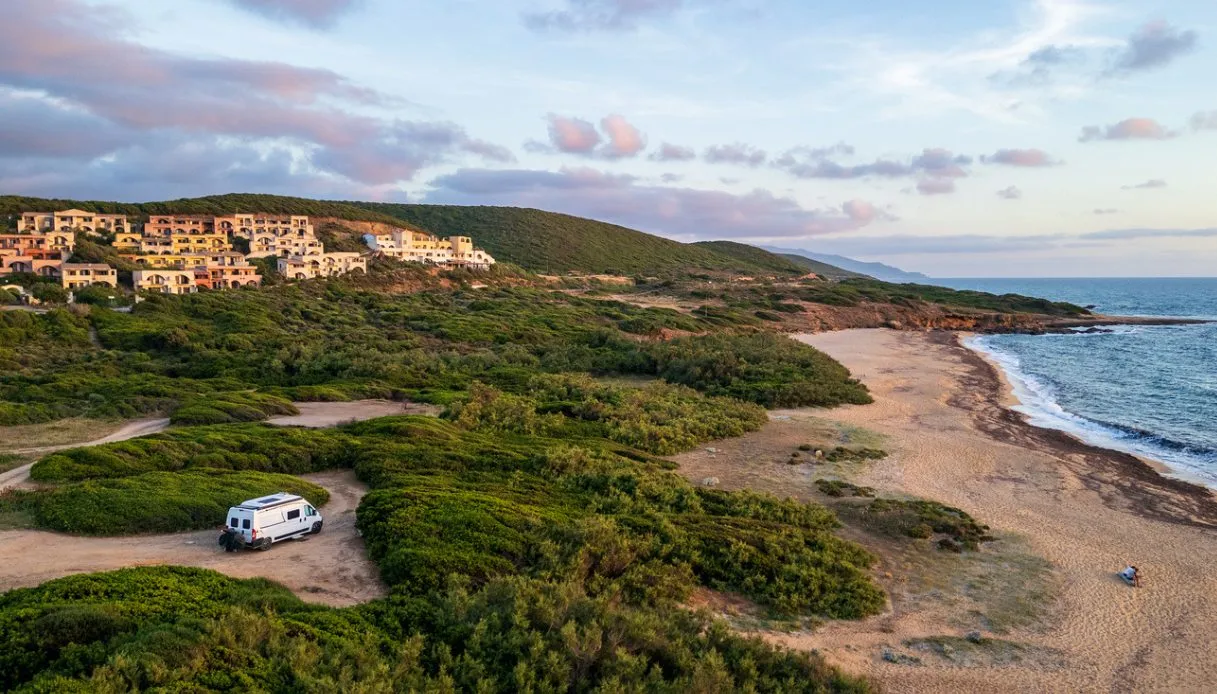
On Sardinia’s western coast, between Capo Frasca and Capo Pecora, a stretch of about 47 kilometers known as Costa Verde remains fairly off the tourist radar. The geographic reference mainly concerns the coast between Arbus and the Piscinas area, even though the landscape and mining history extend further south.
The green of the name belongs to the vegetation that blankets the hills and the slopes of the cliffs. Junipers, lentisks, myrtles, strawberry trees, and gorse alternate with sandy expanses, rocks of shifting colors, and valleys traversed by solitary roads. In some stretches the landscape takes on an almost desert-like appearance, with dunes advancing from the interior toward the sea and the mistral busying itself with continually redefinition of their profiles.
What makes the Costa Verde distinctive is above all the contrast between nature and the traces left by humans: for over a century these mountains fed an intense mining activity. Lead and zinc departed from the Montevecchio and Ingurtosu mines, while villages, galleries, warehouses, and facilities grew around the miners’ work.
Guspini, the starting point toward the ancient mining district
Guspini lies inland, on the edge of the area leading toward the Montevecchio mines. The town represents a useful base to begin exploring the Costa Verde, especially for those who want to understand the link between the local economy and the underground resources.
The historic center deserves a stop before heading into the hills: the streets, squares and religious buildings restore the image of a settlement tied to the agricultural and pastoral traditions of Medio Campidano. The presence of local activities allows for a peaceful pause, before leaving the town behind and venturing into a landscape that gradually grows more wooded.
Montevecchio, the great city of lead and zinc
The Montevecchio mining complex is one of the most important testimonies of Sardinia’s industrial archaeology. The mining activity played a decisive role from the mid-1800s until 1991, transforming a mountainous area into a complex production center, with offices, housing, facilities and services for the workers’ community.
A visit helps to understand the complexity of that system. The Directorate Building, a representative edifice of the mine’s administrative power, tells of the managers’ role and the organization of work. Around it rise other structures tied to village life and the processing of the ore, while the shafts and facilities recall the concrete dimension of the labor activity.
Ingurtosu, the mining village with ghostly charm
Closer to the Piscinas area, Ingurtosu appears among the hills with the look of a settlement left to the margins of time. The village arose and expanded around the mines, active for decades until the final closure of the complex in 1968. Its history is closely linked to that of Montevecchio, though the atmosphere of the two places presents different shades.
The architectural symbol of Ingurtosu is the Directorate Palace, also known as Ingurtosu Castle. The building was constructed at the end of the 19th century to house offices and spaces intended for mining managers. The structure, with its austere appearance and commanding position, evokes the village’s hierarchical organization, in which life revolved around the extraction activity.
Around the palace you encounter service buildings, residences, warehouses and structures now marked by the passage of time. Some spaces still preserve legible elements of their original function, others show deteriorated walls, empty openings and surfaces worn by the weather.
Piscinas, the Sardinian desert shaped by the mistral
The Piscinas dunes represent the best-known image of the Costa Verde and one of its most extraordinary geographic features. The dune system reaches heights of around 60 meters and extends far inland, creating an environment that resembles desert landscapes.
The sand, carried and redistributed by the wind, forms ever-changing elevations. The mistral acts as an tireless artist, altering the ridges, accumulating new layers, and pushing grains toward the vegetation. Junipers and Mediterranean shrubs emerge from the golden expanse, with roots and branches adapted to harsh conditions.
Portu Maga and Gutturu e Flumini, the most secluded coastal landscape
Among the Costa Verde locations, Portu Maga preserves a secluded character, with hills approaching the sea and Mediterranean vegetation softening the presence of settlements. The small settlement is also known to surfing enthusiasts, thanks to the wind conditions affecting this stretch of the western coast.
The road then reaches Gutturu e Flumini, places whose name recalls the presence of water and natural streams. Here the landscape is dominated by scrub, dunes and hills, with a sense of isolation that belongs to many stretches of the Costa Verde.
Funtanazza, between the marine colony and the hills
Funtanazza preserves a particular testimony of the territory’s social history: among the coastal vegetation rise the remains of the old marine colony built in the 1950s to house the miners’ children. The building, now an integral part of the landscape, tells of an era when mining companies organized welfare and lodging for workers’ families.
The abandoned complex, seen from the coast, creates a sharp contrast with the surrounding environment. The shapes of modern architecture clash with the cliffs, pine trees, and Mediterranean scrub, while time has left on the walls marks of exposure to the elements.
Scivu, the sand that “speaks”
Then there is Scivu, best known for the phenomenon of talking sand, a sonic effect produced by some particularly fine and dry grains that can generate a sound akin to an echo underfoot. The phenomenon varies with environmental conditions, but it adds to the uniqueness of this stretch of coast.
Behind the shore lies a dune-dominated environment rich in vegetation, naturally connected to the Piscinas system.
Capo Pecora, the southern boundary of the Costa Verde
Capo Pecora marks the southern limit of the Costa Verde and is a promontory characterized by pink granite rocks, shaped over time by the actions of wind and sea. The stone’s color shifts with the light, moving from warm tones to cooler hues as sunset approaches.
The promontory features cliffs, small coves, and stretches of rocky coastline. The smooth forms of the boulders and the low vegetation create a stark environment, particularly suited to those seeking landscapes far from the more built-up areas.