
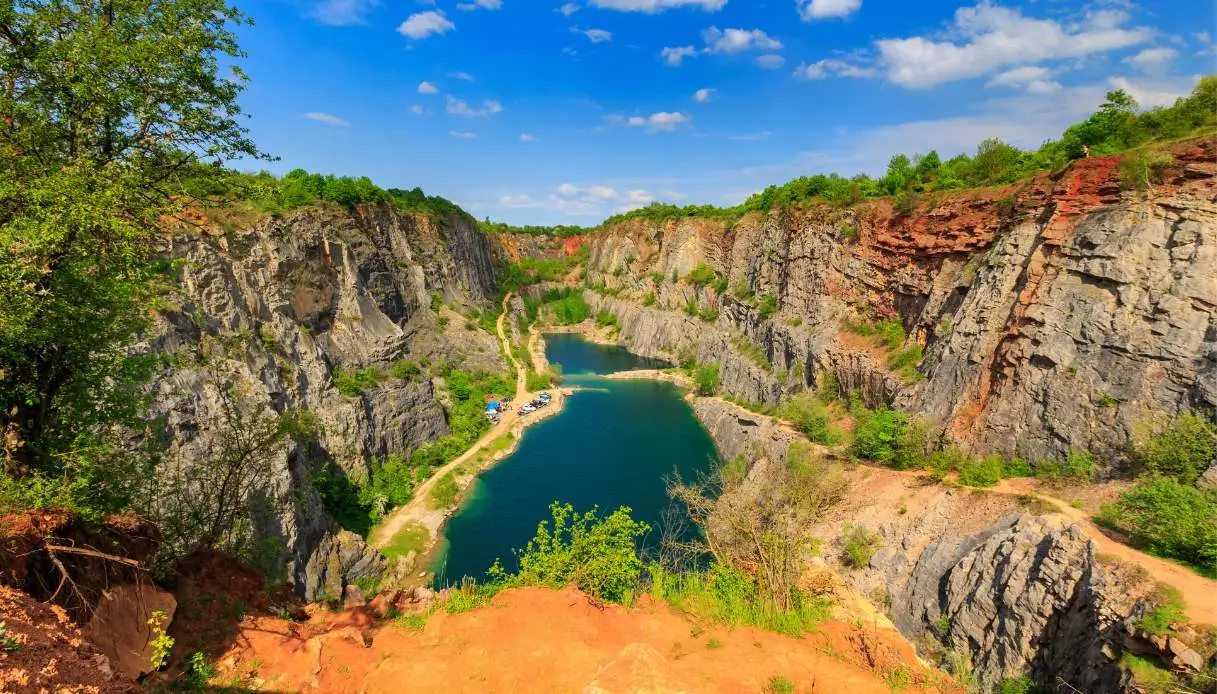
Just a few kilometers from Prague, the Bohemian countryside hides a monumental crack in the rock—a vast cavity with pale walls whose bottom gleams with waters of a blue that almost defies belief. It looks like a corner of an American canyon transported into Central Europe, yet Velká Amerika’s story is far less wild than the landscape might suggest.
The nickname “Czech Grand Canyon” springs from its sheer scale. Velká Amerika, which in the local language means “Great America,” is the largest among the limestone quarries in the Mořina area. The basin measures about 800 meters in length, 200 in width, and drops nearly 100 meters deep. Those numbers, seen from above, carry a daunting weight.
On one hand lies the allure of a landscape returned to nature, on the other the memory of intense mining activity and a painful chapter of history. The quarries in the area were indeed associated with labor camps for political prisoners during the communist regime. Today vegetation has reclaimed portions of the slopes, but the industrial past still surfaces in the shape of the terrain and in the network of tunnels that cuts through the underworld.
Origin, formation, and legends of Velká Amerika
The story of Velká Amerika begins with limestone, a sedimentary rock formed in ancient geologic times and particularly common in the Bohemian Karst. The region around Mořina is rich in karst formations, with hollows, gorges and subterranean systems shaped by water and the rock’s structure. From the early 20th century, the area was exploited for limestone extraction, an activity that profoundly altered the landscape.
Velká Amerika became the largest quarry in the complex, flanked by other pits bearing equally curious names, including Malá Amerika, the “Small America,” and Mexiko, the “Mexico.” The different basins are linked by underground galleries, and the system comprises passages laid out over six horizontal levels, dug to accommodate the miners’ work and the transport of ore. In some stretches the rails once used are still visible. Water subsequently flooded part of the cavities, forming lakes with a crystal-clear and intense color. At the bottom of Velká Amerika lie two bodies of water connected to one another, while Malá Amerika also features a lake.
Mining ceased in the 1960s and, thereafter, water collected in the great depression, while trees and vegetation reclaimed the banks of the quarry. What once was an industrial wound in the landscape now reads as a natural stage of imposing power.
The darkest chapter concerns the use of the quarries as sites of forced labor for political prisoners between the late 1940s and the 1950s. The memory of that era contributes to the distinctive atmosphere of Velká Amerika. The limestone walls, the tunnels and the basin’s depth can evoke a place of isolation and toil, far removed from the romantic image suggested by the lake.
A number of legends have grown around the quarry. The most famous concerns Hans Hagen, a mysterious figure described in local folklore as a German SS soldier. According to tales, his ghost would suddenly emerge from the galleries and vanish again without a trace. In the local stories, he is credited with deaths and disappearances that were never clarified.
Also the oak known as the Dub Sedmi bratří, the Oak of the Seven Brothers, along the regional hiking path, has its own legendary backstory: the tree supposedly gave name to a tale in which seven brothers who stole together would meet at its foot to divide the loot evenly.
Visiting Velká Amerika, among panoramas, trails, and cinema
Direct access to the bottom of the quarry is prohibited. Velká Amerika belongs to the company Lomy Mořina s.r.o., and the ban is primarily about safety: the walls are steep, the ground treacherous, and the presence of deep water makes the descent especially dangerous. There is therefore no traditional admission ticket or set opening hours. The proper way to visit is to observe from above, along the viewpoints and authorized paths.
The main viewpoint is near the parking lot and allows you to admire the vastness of the quarry without approaching the more hazardous stretches. From this vantage point the vertical walls, the lake, and the vegetation that covers some slopes stand out. Since 2008, a yellow-marked hiking trail has run along the northern edge of the quarry, with several viewing platforms.
The route offers various perspectives of this corner of the Czech Republic and continues toward the Mexiko quarry, then toward Karlštejn Castle. The full walk around the perimeter takes about an hour, while the path toward Karlštejn allows turning the visit into a broader excursion through the woods and countryside of Bohemia.
One of the more interesting possibilities concerns the underground, but Velká Amerika’s galleries can only be visited through authorized initiatives. Another opportunity is offered by the annual event European Day of Protected Areas, during which a didactic route, a guided hike, and the crossing of a gallery between Dub Sedmi bratří and Malá Amerika can be arranged.
The appeal of Velká Amerika has also captured the cinema. The landscape has appeared in Czech and international productions, including the Western Limonádový Joe aneb Konská opera, known in Italian as Limonata Joe, and the adaptation of Andersen’s fairy tale The Little Mermaid, with Libuše Šafránková. More recently, the quarry has served as a setting for international productions such as The Wheel of Time, Carnival Row, Hanna, Britannia, Army of Thieves, and Jan Žižka. Among the better-known titles is also Nosferatu, featuring Bill Skarsgård, Willem Dafoe, and Lily-Rose Depp.
Location and How to Get There
Velká Amerika is located near the village of Mořina in central Bohemia, about 8 kilometers from Karlštejn and almost 30 from Prague. The driving distance from the city center is roughly 45 minutes, though traffic can noticeably alter the timing.
By car, the practical navigation reference is Lom Velká Amerika, Mořina, 267 17 Mořina. From Prague you can reach the area via local roads through Chýnice and Mořina, or by using alternative routes via Radlická and the D5/E50 motorway, depending on your starting point.
For those who prefer public transport, bus 311 from Prague’s Zličín terminal goes to the Mořina stop. The ride lasts about 50 minutes and passes through fields and small towns. An evocative alternative is to reach Karlštejn by train from Prague’s main station, Praha hlavní nádraží, and then continue on foot toward Velká Amerika.