
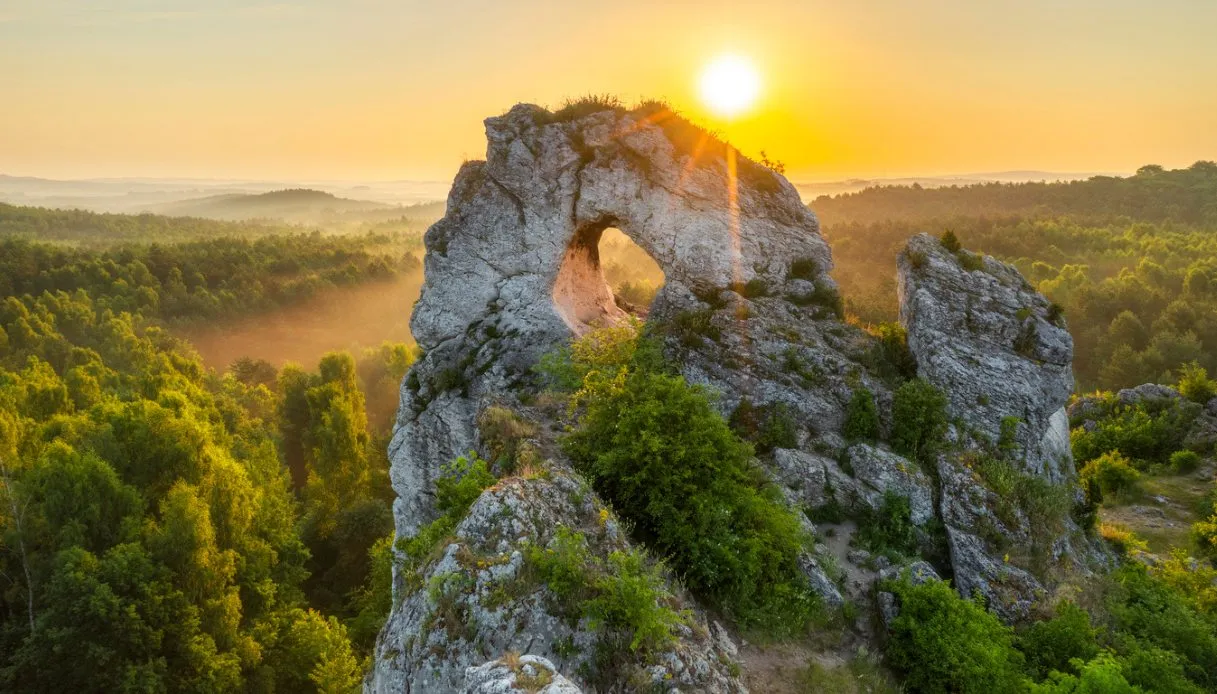
Just outside Zawiercie, in the Polish Silesia countryside, the landscape is characterized by open fields, secondary roads, and vegetation that seems to have taken over everything. Then, at a certain point, all this beauty gives way to a limestone cliff over 30 meters tall, almost disproportionate to the surrounding environment. And there, if you look closely, you notice a large hole in the upper part, today known as Okiennik Wielki.
Okiennik derives from okno, “window”, while Wielki means “large”. Also known as Okiennik Duży and Okiennik Skarżycki, it boasts a natural opening measuring about 7 meters in depth and 5 meters in diameter, dimensions sufficient to transform it into something like a balcony carved into the mountain.
From afar, the boulder resembles a fortified ruin. Up close, however, irregular walls, fissures, blocks stacked at the base, and the profile of the window become visible, through which the sky appears framed by the rock.
Origin, Formation and Legends of Okiennik Wielki
The area where Okiennik Wielki takes shape is mainly characterized by limestone rocks formed millions of years ago in ancient marine environments. Over time, the action of water, frost, temperature fluctuations, and erosion have sculpted the rock masses, eroding away the most vulnerable parts and leaving behind walls, towers, spires, and isolated blocks.
These formations are called in Polish ostańce, a term translatable as “residual rocks” or “isolated monoliths.” They are what remains of ancient limestone ridges after a long natural demolition process. Okiennik Wielki belongs to this family, but it has a peculiarity that immediately distinguishes it from other outcrops: in its wall, a cavity of exceptional dimensions has opened, so regular in shape that it seems like a window intentionally carved.
But the great rocky arch is only the most spectacular part of a larger complex. Around the main cliff, there are other rocks, passages, and piles of stone that give the place a nearly castle-like appearance. From this resemblance, numerous hypotheses about Okiennik’s past have arisen.
According to local traditions and some historical reconstructions, between the XIIth and XIIIth centuries a fortified wooden settlement would have arisen at the foot of the rocks. The wall with the window could have served as the donjon, i.e., the central and most protected tower of a medieval fortress. In the rock, holes and traces have been identified that could be connected to the anchoring of wooden structures.
Stories handed down over time have then added a more legendary tone: the rocks would have been used as a shelter from brigands, figures very present in the region’s popular imagination. Among the names associated with Okiennik is Malarski, described in tales as a charming man, beloved by women and generous to the poor. His fame evokes the Polish tradition’s Robin Hood. According to the legend, he would have stolen riches from the well-off to help those in need, until he was killed by a gendarme disguised as a beggar.
Beyond the stories, the most surprising fact comes from prehistory: in the Jaskinia w Okienniku Wielkim, a cave located beneath the formation, flint tools dating to about 60,000 years ago were recovered.
Visiting Okiennik Wielki, what to see and do
Entrance is free and, for those who only wish to admire the formation, the visit can be fairly brief. From the point where you typically park, the walk to the rocks takes about 5–10 minutes on foot, at a distance of roughly 200 meters. The route crosses a short forest stretch and continues over uneven ground, with a slight elevation.
The limestone wall rises before the eyes and the window appears high up, large enough to immediately convey the place’s name. It is advisable to observe it first from below, because the perspective helps grasp the proportions of the formation and the relationship between the opening and the wall.
The most interesting point is naturally the large hole. The entrance, via a short passage equipped with a rope or through an access suitable especially for those with rock-climbing experience, can vary depending on ground conditions and the maintenance of handholds. For this reason, reaching the viewpoint at the base of the formation is one thing; entering the window is another.
The rocks are indeed frequented by climbers, and those without experience should avoid attempting improvised vertical passages. The window is spectacular even when viewed from below, and the surrounding panorama already rewards the short ascent. It is certain, in fact, that for climbing enthusiasts Okiennik Wielki represents one of the Jura’s best-known areas: the main wall, called Ściana Czołowa, reaches about 35 meters and hosts numerous routes of varying difficulty.
For those who prefer a less vertical experience, the best way to enjoy Okiennik is to focus on observation. The light changes rapidly on the light-colored limestone surface, shadows emphasize the edges of the opening, and the view over the surrounding fields gives the sense of facing a natural tower.
Where it is and how to get there
Okiennik Wielki is located in southern Poland, specifically in the village of Piaseczno, part of the Gmina Kroczyce, in the Silesian Voivodeship. The formation sits in the Krakowsko-Częstochowska Jura, a region characterized by limestone elevations, forests, valleys, and remnants of ancient fortifications.
The nearest urban reference point is Zawiercie, about 10 km away. From Katowice, the drive is nearly 60 km, while from Kraków it is roughly 90 km. To reach the area, head toward Kroczyce and then follow signs for Piaseczno. The last stretch leads along a fairly narrow paved road.
For cyclists, the most interesting reference is the Eagle’s Nest Trail cycling section, which connects the Kromołów area to the ruins of Bąkowiec Castle in Morsko. The route passes near Okiennik Wielki and constitutes one of the most enjoyable sections of Jura’s cycling network, thanks to the presence of a road separated from automobile traffic.