
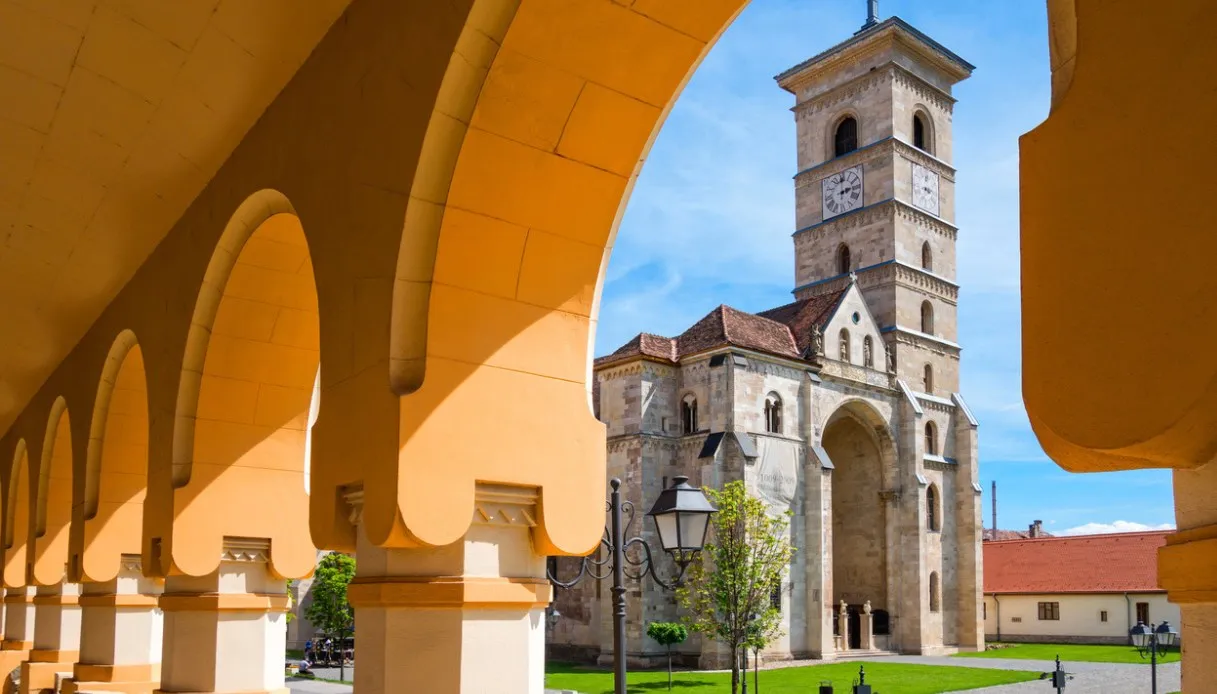
In the heart of Transylvania, along the banks of the Mureș River, Alba Iulia seems almost gathered around its grand citadel. At first glance, many would take it for a quiet provincial town, but reaching the upper part makes it clear that its weight in Romanian history is anything but ordinary.
Ancient Roman Apulum, seat of the princes of Transylvania, capital for a short period of the principalities united by Mihai Viteazul and the scene of the proclamation of the union of Transylvania with Romania in 1918, has accumulated over the centuries a remarkable amount of memories.
Its historic center is dominated by the Alba Carolina Bastion Fortress, a gigantic fortification built by the Habsburgs. Beneath the Habsburg architecture, however, traces of Apulum surface, one of the main military and economic centers of Roman Dacia. Alongside the military structures there are medieval cathedrals, princely palaces, statues dedicated to the protagonists of Romanian history and a library born in the 18th century.
What to See in Alba Iulia
The grand squares tell the official history, while sculpted portals, tombs, inscriptions and fragments from Roman times reveal a much more intimate dimension of this city in Romania.
The Alba Carolina Fortress
Alba Carolina is the absolute symbol of Alba Iulia and one of the most spectacular fortress complexes in Southeastern Europe. Construction began in 1714 after Transylvania came under Habsburg rule, with the aim of creating a powerful defensive structure against the Ottoman Empire.
The fortification covers over 100 hectares and follows a star-shaped plan. Seven large bastions punctuate the perimeter, while moats and additional defensive lines boosted the protection of the structure. The entire military system is accompanied by a richly decorative Baroque ornament, a feature that distinguishes Alba Carolina from many other fortresses in the region.
If the geometry of the citadel appears strict, the six monumental gates introduce instead a spectacular dimension: statues, columns, emblems and bas-reliefs transform the entrances into true works of art.
St. Michael’s Cathedral
Beside the fortress rises the Roman-Caltic Cathedral of St. Michael, considered the region’s most precious medieval monument. The current complex preserves traces of different eras, with a particularly evident layering in architectural forms and decorations.
Inside lie the tombs of important protagonists of Transylvanian history, such as that of Iancu de Hunedoara, prince and military commander remembered especially for his victory in the Battle of Belgrade against the forces of Mehmed II.
The Orthodox Cathedral of the Unification
A short distance away, the Orthodox Cathedral of the Unification creates an interesting contrast with the older St. Michael. The architecture draws on forms of the ancient Romanian tradition, so much so that its bell tower rises over 50 meters and at its feet stand the statues dedicated to the rulers.
The National Union Museum and the Hall of the Union
To understand the historical significance of Alba Iulia one must enter the National Union Museum. The complex comprises historic buildings and collections dedicated to archaeology, history, ethnography and the traditions of Transylvania.
The Hall of the Union occupies a special place in national memory: on December 1, 1918 the union of Transylvania with Romania was proclaimed precisely in Alba Iulia, an event destined to become one of the foundations of Greater Romania. The archaeological collections, meanwhile, go far back in time, to the Roman presence.
The Prince’s Palace
The city’s political history also passes through the Prince’s Palace, located near the Cathedral of St. Michael. Born as an episcopal residence, it was subsequently transformed into a princely residence.
The Batthyaneum Library
The Batthyaneum Library dates back to 1794 and houses an extraordinarily valuable library collection. The collection includes ancient books, manuscripts and incunabula, along with documents precious to the cultural history of Romania and Central Europe.
Among the treasures associated with the library is the Codex Aureus, a 9th-century manuscript linked to the Carolingian tradition and containing parts of the Gospels.
The Vestiges of Apulum
Before the star-shaped walls stood Apulum. The Roman presence represents one of the oldest layers of the city and includes the remains of Legio XIII Gemina, as well as the remains of Roman colonies that developed in the area. Strolling through the citadel, one may encounter a history far older than the surface architecture.
What to Do in Alba Iulia
The citadel invites a slow visit, especially to catch the details that slip by during a hurried journey among the main attractions.
- Crossing the fortress gates: to follow the monumental route between arches, sculptures and Baroque decorations, up to the great Cetății Square.
- Watching the changing of the guard: means seeing the fortress come alive through a reenactment of the military traditions of the Habsburg era.
- Stopping in the citadel square: where you can observe in the same space the Orthodox Cathedral, St. Michael, the Union Museum and the equestrian statue of Mihai Viteazul.
- Seeking traces of Mihai Viteazul: to remember the prince who in 1600 united Wallachia, Transylvania and Moldavia under his rule, transforming Alba Iulia into the capital of the united principalities.
- Reaching the Capitoline Wolf: adds a curious link with Italy. The statue of the Capitoline Wolf suckling Romulus and Remus was donated in 1933 by the city of Alessandria.
Where It Is Located and How to Arrive
Alba Iulia is located in central Romania, in Transylvania, on the banks of the Mureș, about 380 km from Bucharest. The position places it between important regional towns, with Cluj-Napoca to the north and Sibiu to the south. By car, the town can easily be included in a Transylvania itinerary, especially for those who want to alternate historic centers, castles and mountain landscapes.
The journey from Bucharest takes several hours, while Sibiu and Cluj-Napoca offer shorter and more practical connections for building a regional itinerary. Alba Iulia leaves above all the sense of being a city enclosed within a larger city, with Roman Apulum beneath the Habsburg fortress and the memory of modern Romania embedded among cathedrals, palaces and bastions.