
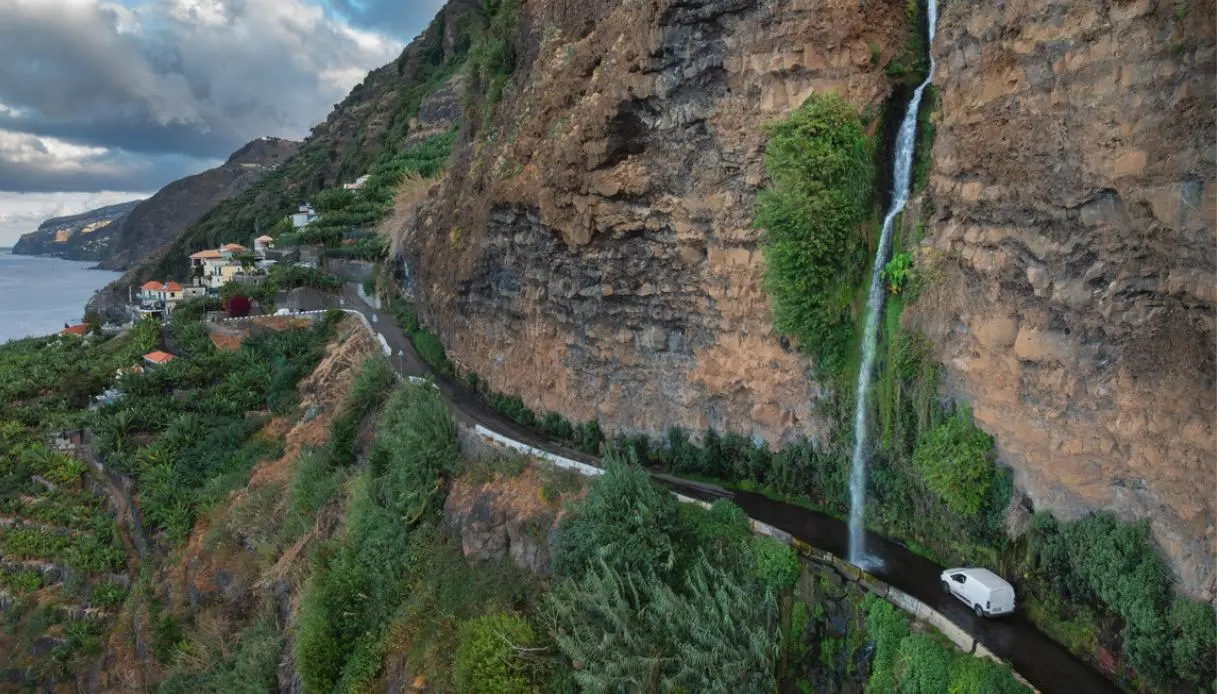
Among Madeira’s most curious images, the Portuguese island of the archipelago that bears its name features a scene that can still surprise even those who have already seen spectacular waterfalls. Here, the water cascades down a rocky wall, crosses an old coastal road, and continues toward the sea. For years, beneath that spray, cars slowed to a crawl until they passed through a kind of natural car wash, while visitors would stop with towels and cameras.
The name is Cascata dos Anjos, meaning “Cascade of the Angels,” and its charm lies precisely in this unusual encounter between landscape and infrastructure. The scene sits on Madeira’s southern coast, a stretch of the island famous for its mild climate, where the mountain seems to meet the sea almost directly.
Today, however, the tale of Cascata dos Anjos must begin with an important clarification: access to the site is forbidden by authorities for
Origin, formation and legends of Cascata dos Anjos
To understand Cascata dos Anjos one must start from Madeira’s own nature: the island is of volcanic origin and features a very rugged terrain, with mountains, deep valleys and slopes that descend rapidly toward the ocean. Rainwater collected in the higher areas feeds streams and irrigation systems, contributing to the presence of numerous cascades along the slopes.
The Cascata dos Anjos, in particular, is tied to the runoff from the elevated hillside area above, a irrigation system built on the island to transport water toward the agricultural lands. The levadas (as they are called in the local language) constitute one of the most characteristic works of the local landscape.
The jet of Cascata dos Anjos also stands out for its path. Instead of ending in a natural basin or a pool among the rocks, the water reaches the old coastal road, spills over the edge, and continues toward the sea. On one side, the damp, dark mountain; on the other, the bright expanse of the ocean; in the middle, a thin road line crossed by the water.
But why is it named like this? According to popular lore, the angels would have descended from the sky to bathe in the fresh waters of the cascade, drawn by the sight of the ocean.
The visit, the road and the landscape to observe
For years the Cascata dos Anjos was a brief and singular stop during a journey through the western part of Madeira. Its appeal did not rely on a grand monument, a challenging trail, or visitor facilities. The point of interest was the waterfall itself, perched above a road facing the Atlantic.
Travel accounts describe a simple scene: people would leave their car nearby, reach the stretch of road, and pause for a few minutes in front of the water. In the past, some drivers drove through the spray to achieve a sort of natural car wash; others stood under the waterfall to cool off, especially on the hottest summer days.
This very combination has made Cascata dos Anjos one of the most photographed spots along the Ponta do Sol coastline. Its fame has grown largely thanks to social networks, which have rewarded the oddity of the image even more than the size of the fall. The jet, in fact, is relatively slender and continuous, more like a ribbon of water than a large, impetuous cascade.
Yet the surrounding landscape certainly deserves attention. Madeira’s southern coast alternates between rugged cliffs, lush vegetation, terraced crops and small settlements. The ocean remains a constant dramatic presence, especially in the late afternoon hours, when the oblique light accentuates the profile of the cliffs and colors the water with metallic reflections. The nearby Ponta do Sol is known precisely for its favorable sun exposure and for its Atlantic sunsets.
The visit, as already noted, is not allowed today. The stretch of the old ER101 affected by the cascade is subject to prohibition, and Madeira’s official tourism advises against access due to the risk of landslides, falling rocks, slippery ground and recorded accidents.
Where Cascata dos Anjos is located
Cascata dos Anjos is located at Anjos, in the territory of Ponta do Sol, on Madeira’s southwest coast, Portugal. The site is associated with the old coastal road ER101, along the historic link between Ponta do Sol and Madalena do Mar. The waterfall plunges directly onto the roadway, before continuing toward the ocean.
Ponta do Sol is about 30–35 minutes by car from Funchal, though times can vary based on traffic, the chosen route, and road conditions. The modern coastal route makes the area easily reachable, while the old Anjos road belongs to a historic road network, narrower and more vulnerable than contemporary infrastructure.
For those who wish to know the landscape without approaching the restricted stretch, Ponta do Sol represents an interesting base for exploring the southern coast. The town retains a compact atmosphere, with buildings facing the sea, sloping streets and viewpoints over the ocean. In the surrounding area there are also other natural attractions, including Praia dos Anjos, a beach of basalt cobbles and dark sand located along the coast between Ponta do Sol and Madalena do Mar.