
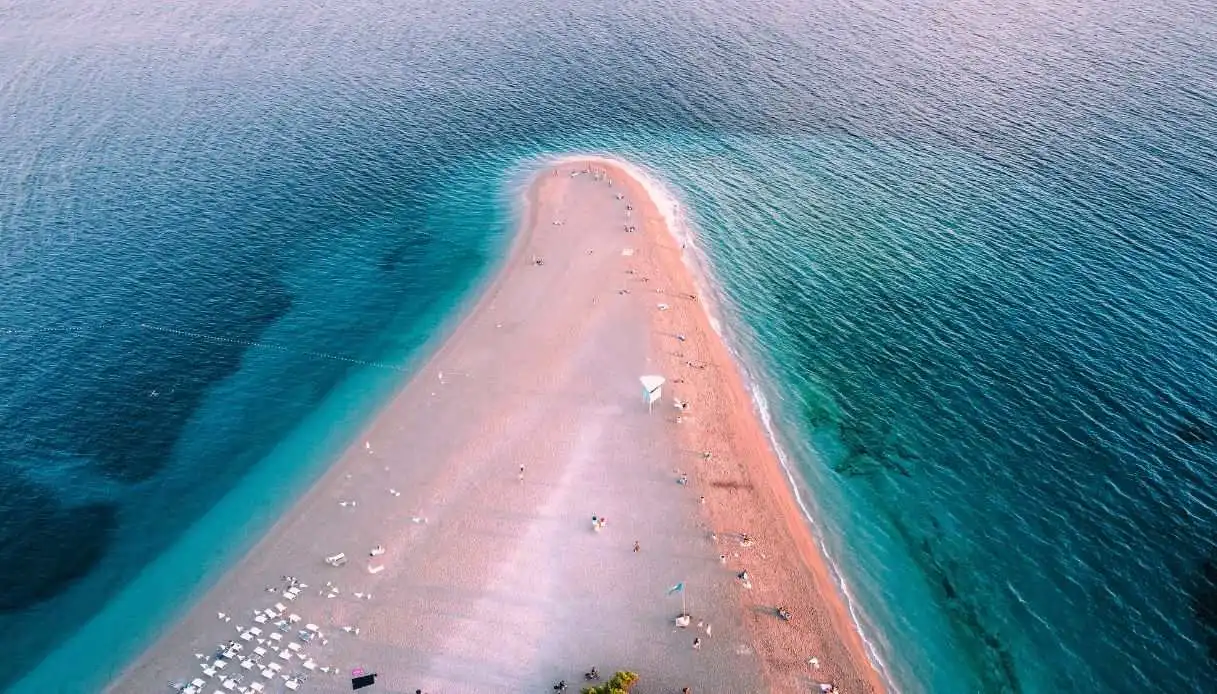
The most photographed beach in Croatia? Undoubtedly the famous Zlatni Rat, ranked 37th in the 2026 Europe – World’s 50 Best Beaches list.
It sits on the island of Brač, in front of the town of Bol, and it stretches into the sea for about four hundred meters with its distinctive pointed shape. Despite the constant flow of visitors, it remains a place that leaves you speechless: white, smooth pebbles, water shifting from turquoise to deep blue, a pine forest offering shade from the sun, and the cliffs rising behind it compose a scene among the most beautiful in all of the Dalmatia.
And it’s never really the same beach twice: waves, wind, and currents continuously reshape its boundaries, so the sea can be calm on one side and choppier, perfect for surfing, just a few steps away.
Why Zlatni Rat Is a Special Beach
At first glance Zlatni Rat, among Europe’s most beautiful beaches, may simply look like a long tongue of pebbles jutting out toward the sea. But it is only when viewed from above that you understand why it is so different from most Adriatic beaches. Its tip continually changes shape, driven by wind, waves, and currents: sometimes it bends to one side, sometimes to the other, and during periods of more intense storms the profile can visibly transform in just a few days. It’s no accident, therefore, that no two photographs of Zlatni Rat are perfectly identical.
The beach extends for almost 500 meters and, from 2006 to today, surveys show that it has naturally lengthened by about 80 meters, without any human intervention: Zlatni Rat grows and changes literally before the eyes of those who visit it. The sensation underfoot is also unusual. It isn’t a sandy beach, yet it isn’t a classic Dalmatian rocky beach either: its small, smooth pebbles make it much more comfortable for walking and sunbathing than many pebble beaches along the Adriatic.
What to do at Zlatni Rat
Zlatni Rat is perfect for a day of relaxation. Given the enormous influx of visitors, practically everything you might need for a day at the sea can be found here: showers and restrooms, loungers and umbrellas, beach bars and kiosks, restaurants, shops, and rental points for beach gear.
For those who can’t stay all day under an umbrella, the sport to practice is windsurfing. Bol is considered one of the most attractive destinations in all of Croatia, and much of the action centers around Zlatni Rat. The merit goes to the maestrale, a strong and steady wind that blows from April to October and which, according to several local guides, usually peaks in the early afternoon and then drops toward evening.
Those seeking a slower pace can instead head uphill: a hike to Vidova Gora, the highest peak on all the Croatian islands, offers panoramic views that span Brač, Hvar and beyond, more than adequately rewarding the effort of the climb.
Where it is and how to get there
Zlatni Rat is located on the southern coast of Brač, the largest island in central Dalmatia, opposite the town of Bol. To reach it, the most convenient starting point is Split: from here daily ferries with cars head to Supetar, the island’s main port, with a crossing of about 50 minutes, and faster catamarans that connect Split directly to Bol. From Supetar, those traveling without their own vehicle can continue by bus or taxi to Bol, which is about thirty kilometers away.
Once you arrive in town, the beach is reached on foot by walking along Put Zlatnog rata, a shaded promenade about 1.5 km long that links Zlatni Rat to Bol’s historic center, the bus station, and the ferry wharf.