
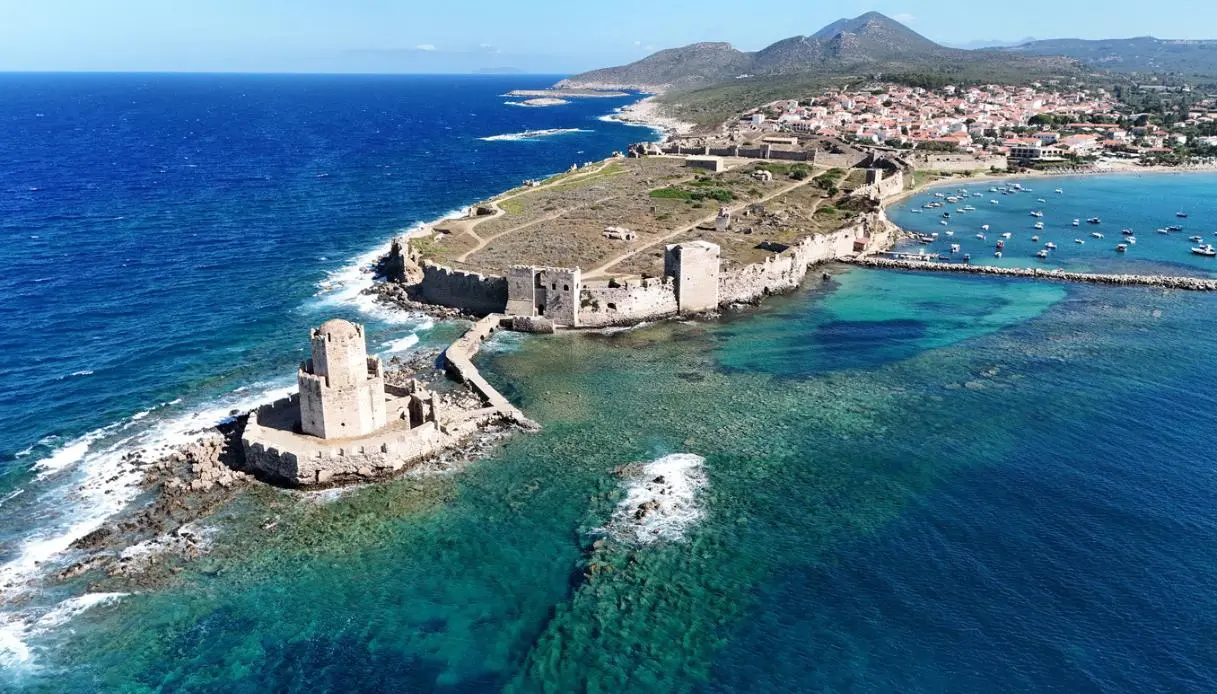
In the southwest of the Peloponnese, at the westernmost tip of the peninsula, the Methoni Castle seems almost stitched to the seascape. Its grand fortress occupies an entire rocky promontory facing the Ionian Sea, with walls that trace the shoreline and a gaze directed toward Sapienza Island and the surrounding archipelago.
It covers about 93,000 square meters and is considered one of the largest fortified complexes in the Mediterranean. More than a mere stronghold, it was a true fortified city, organized to house inhabitants, soldiers, merchants, and travelers. Its position carried enormous strategic value: it controlled one of the seaways used by ships heading toward the Eastern Mediterranean, and for Venice it represented a crucial stop in commercial links.
The most evocative feature, however, arrives at the end of the peninsula, with the Bourtzi. An octagonal small fortress rises on a islet connected to the citadel by a footbridge. It looks almost like a miniature castle, but its function was anything but decorative.
A Brief History of Methoni Castle
The history of Methoni traces back to antiquity, but the appearance of the present fortress is largely tied to the long Venetian presence. In 1209 Venice began the construction of the citadel, transforming the promontory into a military and commercial outpost of primary importance.
For centuries the castle thrived thanks to the harbor and its position along routes to the Levant. Venetian ships bound for the Eastern Mediterranean had the town as an almost obligatory stop. Goods, people, and information passed through its gates, while the fortifications protected an ever more important settlement.
Together with Koroni, located about 30 km further east on the other coast of the peninsula, Methoni formed what the Venetians called the “Eyes of Venice in the Mediterranean.” A nickname that aptly reflects the role of the two fortresses, both placed at strategic points to monitor maritime routes and defend the interests of the Serenissima.
The Venetian phase ended in 1500, after the Ottoman siege. The conquest marked a dramatic turning point for the city, which came under the control of the Ottoman Empire. It was precisely during this phase that the Bourtzi was completed and took on functions related to detention and executions.
In 1686 the fortress returned to the Venetians after the conquest led by commander Francesco Morosini. The interlude was brief: in 1715 the Ottomans retook Methoni and the city once again experienced a phase of commercial and demographic growth.
The fortress also played a role during the Greek War of Independence in 1821. The revolutionaries failed to conquer it and in 1825 Ibrahim Pasha used the port as a base for the Egyptian military campaign in the Peloponnese. The situation changed in 1828, when the French troops of the expedition led by General Nicolas-Joseph Maison forced the Egyptians to surrender.
It was precisely the French presence that left a still visible trace in the access to the citadel. The engineers of the expedition built the stone bridge with 14 arches that crosses the ancient moat, replacing the previous passage with a drawbridge.
After the withdrawal of the troops, the settlement was moved outside the walls and the great citadel gradually lost its function. The stones, however, continued to preserve traces of even earlier eras. An explosion during World War II uncovered structures belonging to the ancient Methoni, while Greek architectural elements were reused in the foundations of some towers.
Visiting the Fortress and What to See
To truly understand this wonder of Greece, a bit of time is needed. The complex is vast, and a rushed visit risks leaving out the most interesting details. About two hours allow you to traverse the different areas with greater attention, leaving room for photographs and sea views.
The entrance preserves a curved arch decorated with Corinthian capitals, while at the sides stand two large bastions: the eastern one dates to the second phase of Venetian rule and is linked to commander Antonio Loredan. The western bastion, also known as Bembo, dates to the 15th century.
Beyond the gate, the monumental staircase gives way to a stone path that crosses what remains of the fortified city. Stretches of the cobbled road that led to the harbor remain, along with the ruins of dwellings, religious buildings, and military structures.
Among the more curious finds are two Turkish baths, evidence of the long Ottoman period. A little further on there are parts of Doric columns, the Church of the Transfiguration of the Savior, and a powder magazine. One of the most scenic features is, however, the monolithic granite column topped by the Winged Lion of Saint Mark, symbol of the Republic of Venice.
On the western side the ramparts belong to the first Venetian phase and are reinforced by five square towers. The natural configuration of the terrain already offered significant protection, thanks to the rocks that made this flank harder to attack. The most thrilling point arrives at the southern edge: the Sea Gate, restored, is composed of two square towers connected by a fortified platform.
From this sector, the passage leads to the Bourtzi islet, with a small footbridge that leads to the octagonal construction. The tower has two floors and features crenellated parapets on both levels.
For archaeology lovers, some details deserve a closer look. Under and inside the medieval structures, elements belonging to earlier phases emerge.
Where It Is and How to Reach It
Methoni is located in the far southwest of the Peloponnese, about 61 km southwest of Kalamata. The village sits on the coast and the fortress occupies the westernmost part of the settlement, directly on the promontory. For those arriving from Kalamata, the route follows the southwestern coast of the Peloponnese until reaching Methoni. The location makes the site particularly suitable for a broader itinerary in Messenia, perhaps pairing the visit with the nearby Koroni or the beaches of the area.
Before or after the fortress, the landscape invites you to continue toward the shore. The beaches of Lambes, Limna, Mavrovouni, and Loutsa add a seaside dimension to the visit, while offshore the islands of Sapienza, Schiza, Agia Marina, and Inouses appear.
The strength of this jewel lies in its size, certainly, but also in its direct relationship with the sea. Behind it remains the history of Venice, the Ottoman Empire, and nineteenth-century Greece. In front, the Mediterranean opens up, the sea that for centuries represented the very reason for its existence.