
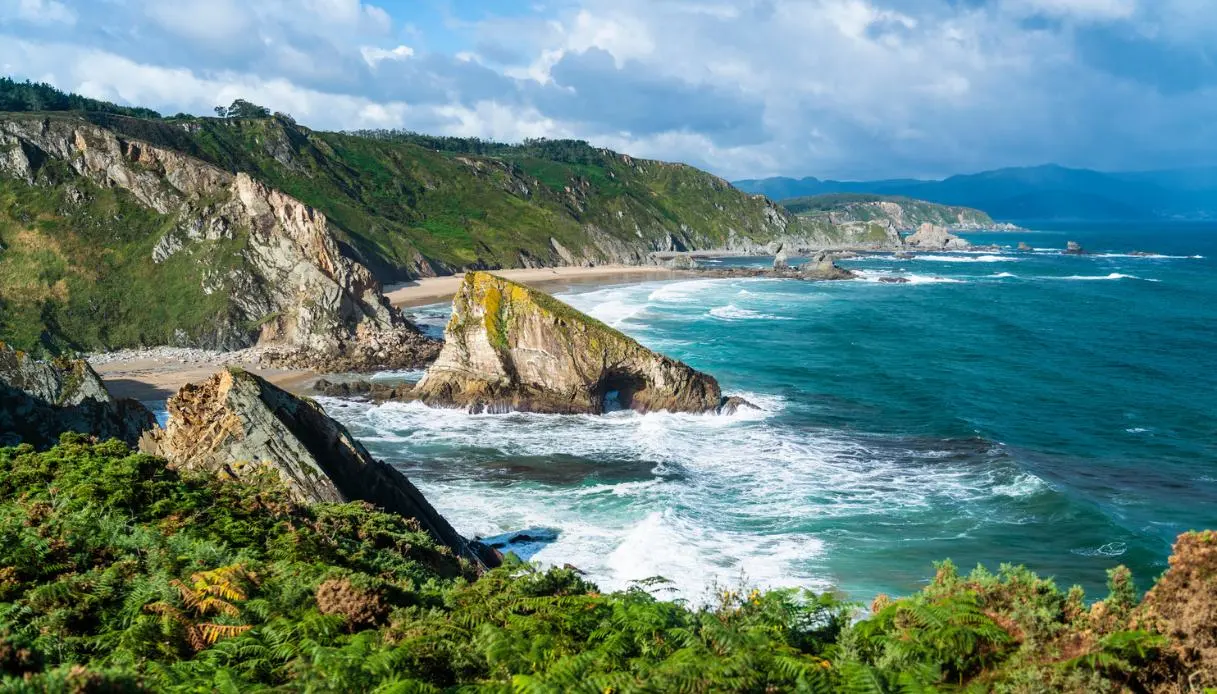
The sunset over the Atlantic helps explain why the ancients called this place Finis Terrae, the end of the Earth. Beyond Cabo Fisterra opened an unknown ocean, vast enough to evoke fear and awe. Centuries later, that same stretch of coastline would receive an equally evocative name, Costa da Morte, linked to the numerous shipwrecks caused by rocks, currents, and storms. Among lighthouses and headlands, sanctuaries facing the sea, endless beaches, and towns with a strong maritime identity, Galicia reveals one of its most powerful landscapes.
Behind this somber designation, however, lives a region deeply tied to the ocean, to the work of fishermen, to pilgrimages, to ancient crafts, and to a nature still capable of imposing its own rhythm.
The rocky cape of Cabo Fisterra extends into the ocean about 3 km beyond the town, and for centuries has been associated with the western limit of the known world. Tradition attributes to the Romans the image of this extremity gazing out over the sea, also linked to the solar cult of the Ara Solis. Watching the sun disk disappear beyond the horizon must have carried a chill for those who pictured the ocean as a mysterious frontier toward unknown lands.
Today a lighthouse crowns the cape, one of the symbols of all Galicia. Here, many pilgrims continue their journey after reaching Santiago de Compostela, and those who complete this extension of the Camino can receive the Fisterrana, a certificate tied to arriving at Fisterra.
Muxía and the Virxe da Barca, sacred stones before the Atlantic
Granite, wind, and sea spray accompany the arrival at the sanctuary of the Virxe da Barca, built on the rocky edge of Muxía. According to legend, the Virgin appeared to the Apostle James on a stone boat. Some boulders near the sanctuary are said to be the remains of that miraculous vessel.
Among them are Pedra de Abalar and Pedra dos Cadrís, elements long tied to popular beliefs, rites, and stories passed down through generations. The devotion culminates in the romería of Nosa Señora da Barca, one of Galicia’s most cherished religious celebrations and recognized as a Festa de Interese Turístico Nacional.
Beside the religious complex you also encounter A Ferida, a large sculpture placed in memory of the 2002 Prestige oil spill disaster, a catastrophe that struck this stretch of Spain’s coastline.
Cabo Vilán and the Cemetery of the English, memory of shipwrecks
To the north of Camariñas, Cabo Vilán presents a stern, almost barren silhouette. Rocks, sea, and wind forge a stark scene, while the lighthouse recalls how perilous navigation along this part of the coast could be. The current installation began operating in 1896, a few years after a string of naval tragedies had drawn the attention of the British authorities to the need to strengthen coastal signaling.
Between Arou, Punta do Boi and Vilán unfolded some of the most tragic episodes in the local maritime history. In 1890 the HMS Serpent crashed against the rocks during a storm. 172 men perished and many bodies were buried nearby, in the place today known as the English Cemetery.
Camariñas, the rhythm of bobbins beside the port
Camariñas has an identity tied as much to the Atlantic as to the delicate threads woven by its artisans. The encaixe de palillos, the local bobbin lace, has become one of the most recognizable cultural elements of the Costa da Morte and has earned fame far beyond Galicia.
The palilleiras move the bobbins quickly following precise patterns, producing a dry and steady sound that accompanies the work. The Museo do Encaixe, meanwhile, tells the techniques, history, and social value of this tradition, while during Holy Week the Mostra do Encaixe attracts artisans and visitors.
Punta do Roncudo, the realm of the percebes harvesters
Near the harbor of Corme, Punta do Roncudo starkly narrates the relationship between the Costa da Morte’s inhabitants and the ocean. The name refers to the roar produced by waves against the rocks, a deep sound that accompanies this exposed promontory.
On the rocks grow percebes, considered among the finest in Galicia. Collecting them requires experience, speed, and an intimate knowledge of the sea’s movements. The percebeiros reach the zones where the waves beat to snatch these crustaceans from the rock in the short windows granted by the Atlantic.
Carnota, between the monumental horreo and an immense beach
Further south the landscape opens around Carnota. The main feature of the town is the great hórreo, a traditional Galician granary raised on stilts to protect the grain from humidity and from animals.
The Carnota horreo reaches about 34 meters and ranks among the largest in the region. The long, narrow structure, built in stone and punctuated by ventilation openings, turns a rural building into a near-monumental presence. Not far away lies Praia de Carnota, a vast sandy stretch with dunes, wetlands, and open spaces.
Ézaro and Monte O Pindo, water and granite on the edge of the ocean
At Ézaro the Xallas river ends its course with a spectacular waterfall before meeting the Atlantic. A few footbridges allow approaching the plunge, while from the upper viewpoint the gaze embraces the estuary, the village, and the coast.
Behind it rises Monte O Pindo, a massive granite massif of about 600 meters nicknamed the “Olympus of the Celts.” Legends, erosion-carved shapes, and ocean vistas have given it a peculiar aura in the Galician imagination.
Dombate and Borneiro, thousands of years before the lighthouses
The Costa da Morte guards traces of humanity far older than its fishing villages, and the Dolmen de Dombate stands as one of Galicia’s most important megalithic monuments. A modern wooden-and-glass protective structure allows visitors to observe the monumental tomb while shielding it from the elements.
Not far away, Castro de Borneiro belongs to the Iron Age culture of fortified villages. Remains of dwellings and defensive structures help reveal how a community lived centuries before the Roman conquest.
Corcubión, the most intimate face of the Costa da Morte
After so many headlands opening to the ocean, Corcubión offers a quieter, more intimate scale. Overlooking the estuary, the town preserves historic buildings and memories of the prosperity tied to seafaring.
Among the principal elements are the Church of San Marcos, the Pazo dos Condes de Altamira, and the Castelo do Cardeal, testimony of a center that played a significant role in local history.