
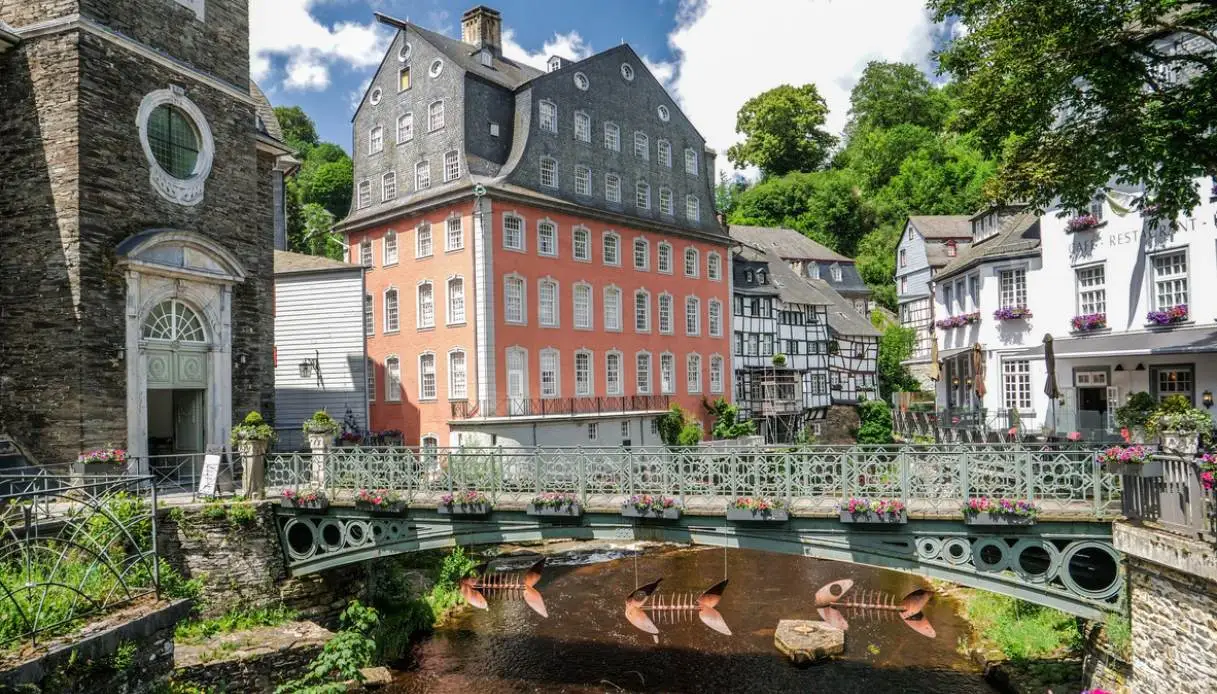
Today we invite you to discover a corner of western Germany where time seems to have stood still for centuries. Among the wooded bends of the Eifel mountain region, just a few kilometers from the border with Belgium, nature has carved a narrow and deep valley. Along this natural hollow flows the Rur River, whose cold, clear waters determined the fortune of an extraordinary settlement: Monschau.
Its precious historic center indeed appears almost wedged between the watercourse and the surrounding elevations. Half-timbered houses, often clad in slate, overlook the narrow, tall façades along the streets. Beside the simpler dwellings stand considerably more imposing residences, a testament to the prosperity the town attained thanks to textile production.
The atmosphere you breathe while strolling along the cobbled lanes is permeated by the deep scent of ancient wood, by the morning mist that rises from the river, and by the cool breeze that descends from the nearby forests. The constant sound of the Rur’s flow accompanies every step, creating a natural soundtrack that resonates among stone bridges and hidden squares.
What to See in Monschau
The beauty of this German town is most evident in the smallest details, such as the signs at the windows and the timber beams of slate-clad façades that cover many buildings.
Old Town, the Historic Heart
The historic center of Monschau gathers hundreds of protected buildings and preserves an urban fabric tightly linked to the valley’s shape. The streets are narrow and irregular, with perspectives that change swiftly just after crossing a bridge or a small square.
One of the most representative viewpoints is near the Evangelische Stadtkirche: from here the gaze embraces the timber-framed façades facing the Rur and yields the town’s most famous image.
Rotes Haus, the Weaver’s House Turned Museum
The Rotes Haus is probably the most important building to understand the wealth Monschau reached during the textile manufacturing era.
Johann Heinrich Scheibler had the dwelling built around 1760, combining living space, commercial activity, and production. The two parts of the house even bore distinct names, Zum goldenen Helm for the residence and Zum Pelikan for the activities tied to trade and textile production.
Inside there are 13 furnished rooms, with furniture and decorations. Rococo, Louis XVI and Empire styles appear across the different rooms, while bedrooms, cradles, set tables, kitchens and personal objects allow a glimpse into the daily life of a very affluent family. What leaves a lasting impression, however, is the grand carved oak staircase, which ascends through three floors with a richly decorated curved structure.
Burg Monschau, the Fortress Above the Valley
Burg Monschau dominates the town from the summit of a rocky spur. Its construction dates back to the last decade of the 12th century, initiated by the Dukes of Limburg.
The position was strategic: from above it was possible to control the Rur valley and the surrounding territory, while the fortress served as the political center of the local domain. Today it preserves remains of the ancient structures and offers one of the most interesting viewpoints on the town.
Haller-Ruine, the Medieval Fragment Above Monschau
Even before the current fortress, the area had known other fortified settlements. Among them appears the so-called Haller-Ruine, situated above the confluence of the Laufenbach with the Rur. The ruins recall an earlier phase of local history and add a second vantage point over the village.
Historische Senfmühle, the Mustard Factory
Monschau’s industrial history is not limited to wool. Mustard has also earned a place in the local tradition.
The production dates back to 1882 and the operation moved through several locations and technical transformations, transitioning from water-wheel power to steam engines and then to electricity. The facility preserves evidence of the old technologies and offers tours dedicated to the production of the Monschauer Senf.
Glashütte Monschau, the Glass Workshop
Another distinctive experience dives into the world of glassmaking. At Glashütte Monschau, artisans show how molten mass is transformed into decorative objects and vessels.
The craft preserves ancient techniques, a tradition practiced since Roman times. The live demonstration helps make the complexity of the trade understandable, with heat, hand tools, and highly precise movements.
What to Do in Monschau
A visit can weave together history, scenery and small local pleasures without the need for a tight schedule. Monschau shines when you let curiosity and unexpected viewpoints take the lead.
- Follow the Rur along bridges and historic façades: the river accompanies the town center and offers some of the best spots to observe the architecture from below.
- Sample the local specialties: Monschau mustard, Printen, Monschauer Dütchen and Vennbrocken tell a culinary tale linked to the Eifel region. During a coffee break it is worth seeking out these treats.
- Plot a scenic route: the hillside trails let you move away from the tourist hub and view Monschau from the outside, with the valley carved among woods and slopes.
- Visit Monschau during Advent: in December the historic center lights up with decorations on the façades, and the Christmas market occupies several spots in the Altstadt. In 2026 it is planned for the four weekends from November 27 to December 20, with around 35 stalls.
- Discover the surrounding villages: Kalterherberg, Konzen, Mützenich and Höfen preserve typical Eifel architectural features and offer a glimpse of a rural landscape very different from Monschau’s center.
Where It Is Located and How to Get There
Monschau is located in North Rhine-Westphalia, in the western part of the Eifel, a short distance from Aachen and the Belgian border. The municipal area spans about 95 square kilometers, with a strong presence of forests and agricultural lands.
For travelers coming from Italy, one of the most practical options is to reach Aachen by train and continue to Monschau via local connections. Aachen is an important rail hub in the region and offers connections to several German and international cities. The town is about 30 kilometers from Monschau.
Once there, the historic center is best explored on foot. For those who prefer to avoid the steeper climbs during the pleasant season, the Stadtbahn Monschau offers a roughly 30-minute scenic ride that passes the fortress and provides views over the valley. The service runs from April 1 to October 31.