
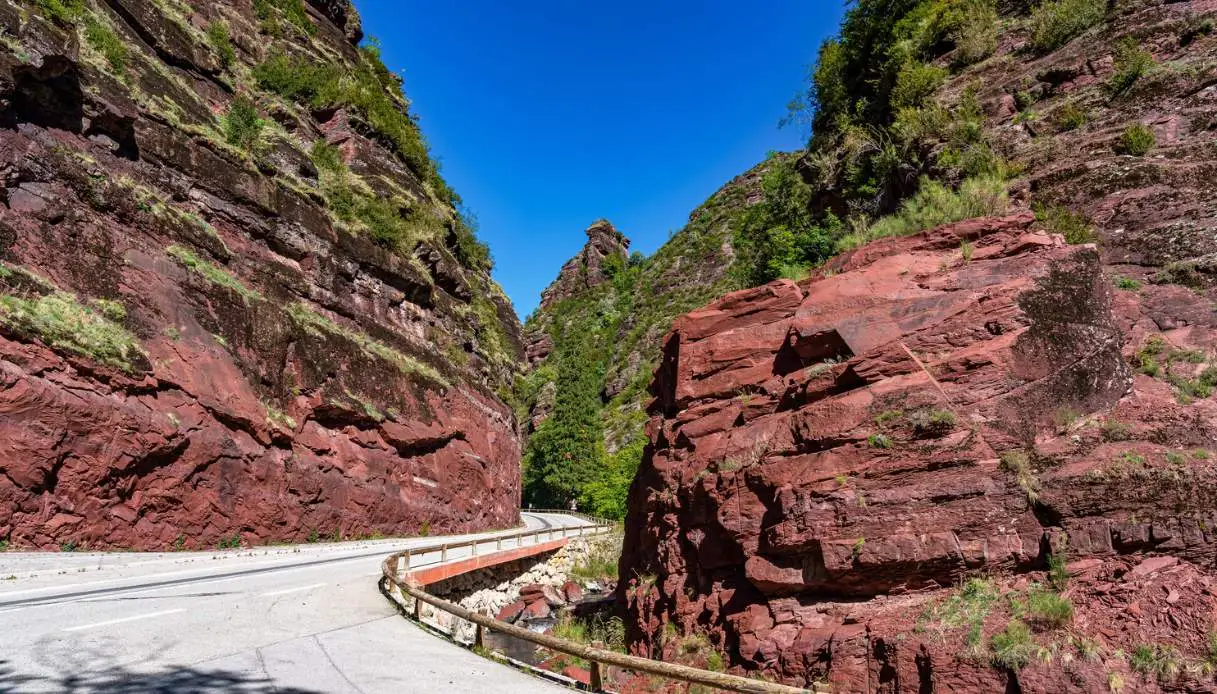
The landscape of the French Riviera is defined by Mediterranean light and wide horizons, yet there is a point where it feels as if you embark on an entirely different journey. In this area, in fact, the D28 road begins to climb inland and, little by little, the panorama tightens, vegetation gives way to rock, while the sky threads through ever-taller walls. These are the Gorges of the Cians, one of the most peculiar settings in the hinterland of Nice, in the territory of the Maritime Alps.
What immediately catches the eye is their distinctive element: the rock takes on deep red tones, brown and copper, creating a contrast that seems almost artificial with the green of the mountain and the clear sky. It is the Cians, a small Alpine stream, that has carved this spectacular natural corridor, running for about 25 km before joining the Var River.
The D28 road runs alongside the stream for much of the journey. At times it stays close, almost at the same altitude, while a little further ahead it climbs along the mountainside, appearing much lower. The result is one of the most spectacular balcony roads in the Maritime Alps, with a roadway reflected in sheer walls and a succession of tunnels that makes the trip even more evocative.
Origin and Formation of the Gorges of the Cians
The story of the Gorges of the Cians is primarily geological. The star of the show is the torrent itself, whose erosive power has shaped the mountain over a very long period. The route winds its way through different rock formations: in the most characteristic section red shales appear, responsible for the color that has made this valley famous. Further along, the landscape also traverses through calcareous zones, staging color and morphological variations along the way.
The purple hue is so dominant that it almost becomes a signature of the Cians. The walls seem ignited by light on clear days and take on darker shades in the shadowed areas. During floods, the erosive force of the torrent greatly intensifies. The water carries debris, strikes the walls, and continues the valley’s sculpting work, giving rise to a series of natural sculptures that accompany the river’s course for about 25 km.
The formation reaches its peak in the Small Gorges and the Large Gorges. In certain stretches the walls come astonishingly close, at about one meter apart, to the point that the mountain seems to almost close back over the watercourse. The route passes through numerous galleries and runs beside walls that leave very little space for the roadway.
Visiting the Scenic Road, Tunnels, and Narrow Gorges
The Gorges of the Cians are experienced primarily from the road. The D28 cuts through the valley and represents the most immediate way to seize its atmosphere. At the wheel, attention is required: the road is narrow and some sections feature particularly tight passages, with rock walls on one side and the mountainside on the other.
It is precisely this compact dimension that makes the journey special, so much so that speed is relegated to the background. It is wise to go slowly, take advantage of available pull-offs for a break, and allow the landscape to unfold. The galleries are an integral part of the experience, and the passage from the outside into the darkness of one of the tunnels creates a nearly cinematic effect. Then the light returns and a red wall, a leap of the torrent, or a new opening to the valley reappears ahead.
The Small Gorges
The Small Gorges represent one of the most spectacular points of the itinerary. The walls tighten around the Cians and the distance between the rock masses becomes minimal.
A parking area downstream of the galleries allows you to park the car and reach the most evocative stretches on foot. It is the part of the route ideal for observing up close the structure of the walls, the stratifications, and the relationship between rock and water.
The Large Gorges
Further on, the landscape becomes even more imposing with the Large Gorges, which highlight the work carried out by the Cians on the mountain.
The red walls rise vertically, while the stream flows much lower. The road transforms into a true natural terrace overlooking the canyon.
The D28 Road
The real guiding thread remains the D28. Its route links the valley with the Beuil area and allows progression toward one of the best-known mountain locales in the Maritime Alps, Valberg.
The route can also be included in a broader itinerary together with the Gorges of Daluis, located to the west of the Cians. The two canyons are often considered complementary for a day dedicated to the spectacular roads of the hinterland of the Côte d’Azur.
The Cians mainly offers the character of red rocks, narrow passages, and tunnels. Daluis adds another environment of deep gorges and walls with colors just as surprising.
Panoramic Viewpoints
Along the road it is worth taking advantage of the available pull-offs to stop. The panorama changes rapidly, and a brief pause can grant a completely different perspective.
From lower elevations the Cians appears as a small torrent tucked into the mountains. From the higher stretches of the road, the valley gains depth, and the canyon becomes much more evident.
Where They Are Located and How to Get There
The impressive Gorges of the Cians are located in the French Maritime Alps, east of the Daluis Gorges and near the Beuil mountainous area. The main reference road is the D28, which traverses the valley.
From the south, access is near the Pont du Cians, along the D6202, on the route between Entrevaux and Malaussène. From the north you reach the Beuil area via the D28 and the D30, along the link between Saint-Sauveur-sur-Tinée and Guillaumes.
From Nice, the inland journey reveals a striking transformation of the landscape: in about an hour and a half you pass from the Mediterranean scenery of the Riviera to a Alpine environment made of mountains, deep gorges, and narrow roads.
For those seeking a destination capable of leaving an unforgettable image in memory, the Cians has an advantage that is hard to ignore: you don’t need a long hike or a complicated itinerary, because it is enough simply to follow the road, enter the tunnels, let yourself be surprised by the red walls, and stop at the right spots.