
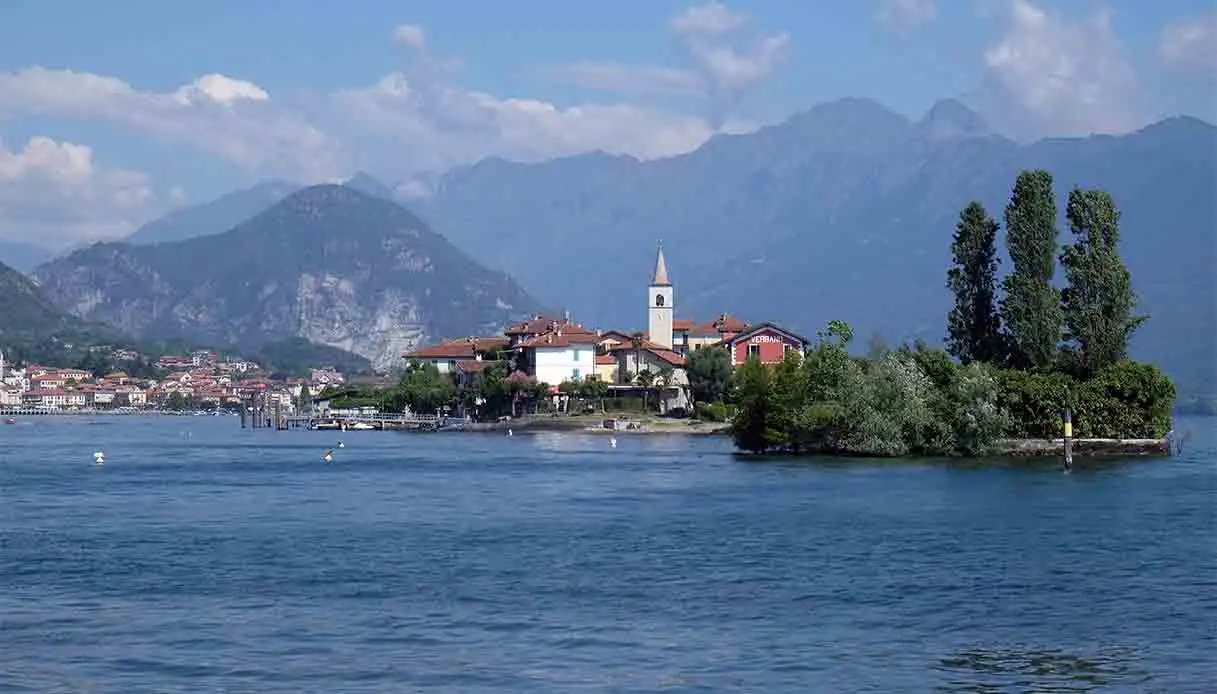
On Lake Maggiore, there is a small archipelago with three very famous islands visited by thousands of tourists every year: Isola Madre, the largest, Isola Bella, the most populated, and Isola dei Pescatori. But not everyone knows that the Borromean Islands also include two islets, one, the Isolino di San Giovanni, private (Toscanini even lived there), and the other, the most curious, is in fact a rock, the Rock of Malghera, but it is also the most intriguing.
The Isola Madre, bella and San Giovanni are privately owned and have belonged to the Borromeo family for centuries; they host palaces and gardens of stunning beauty that can be visited when the pleasant season arrives. The Isola dei Pescatori, however, is state-owned; there are no visiting hours as with the others, you can go there all year round and at any time, even with private boats: it is renowned for its restaurants serving lake fish freshly caught by fishermen who still live there and for the small bed & breakfasts where you can stay. But all this you probably already know.
What you perhaps do not know is that “la Malghera” is also called Isolino degli Innamorati, and we tell you its story.
The Story of the Isolino degli Innamorati
The Scoglio della Malghera is as large as a loft: 33 x 22 meters for a total area of 600 square meters, and it is uninhabited. Almost all of it is covered by forest. It has only a small, very romantic beach, pebbled, on the south side frequented by the lake’s gulls, sometimes by a few cormorants, and by couples who land there with small boats, which is why it is called Isolino degli Innamorati. Its hidden beach nestled among the vegetation was, in the past, a refuge and favorite destination for couples seeking privacy.
Curiosities and Legends
The old name of the Scoglio della Malghera might derive from “malga,” understood as a wild, uncultivated place and a natural shelter for the fauna and birds of the lake. An ancient legend defined this islet as the The Rock of the Nymphs. And here is the tale that circulates and that the oldest locals pass down to future generations.
In ancient times, the waters of Verbano were infested by a huge fierce dragon that lived in a cave in the lake’s deepest part, toward the Lombard shore (Lake Maggiore, in fact, is partly in Piedmont, partly in Lombardy, and partly in Switzerland). The beast attacked boats, devoured fishermen, abducted maidens, and ruined all the crops. Desperate, the fishermen decided to appeal to the lake’s most beautiful and gentle nymph, Ambra, who, along with many other nymph companions, lived in the most pleasant places of the area. Ambra, moved, listened to the pleas and cries of the fishermen. Armed only with her beauty, one day she went to the monster’s cavern to try to soothe him; however, the dragon’s fury was such that the nymph, in order not to be devoured, found herself forced to promise him to become his bride if he spared her and calmed down. With this proposal, the dragon’s anger subsided and Ambra was able to return safely to her companions.
The fishermen, however, saw that after a few days the dragon swam freely in the lake’s waters and they did not trust the nymph’s promise. It was thus established that, after two days, at sunset, Ambra would appear with the monster on the rock that rises between Isola Bella and Isola dei Pescatori and, surrounded by all the other nymphs, she would publicly make him promise to respect the fishermen, their maidens, and not to ruin their crops again. And so it was.
On the appointed day, at sunset, Ambra and the monster appeared on the small islet. Seated beside the dreadful fiancé, the nymph sang pastoral tunes accompanied by the other nymphs who swam in the waters. Finally, the fishermen, seeing the dragon moved by the songs and as calm as never before, were convinced that they were safe. Since then, in memory of this event and in honor of the generous savior, the fishermen named that islet “The Rock of the Nymphs.”