
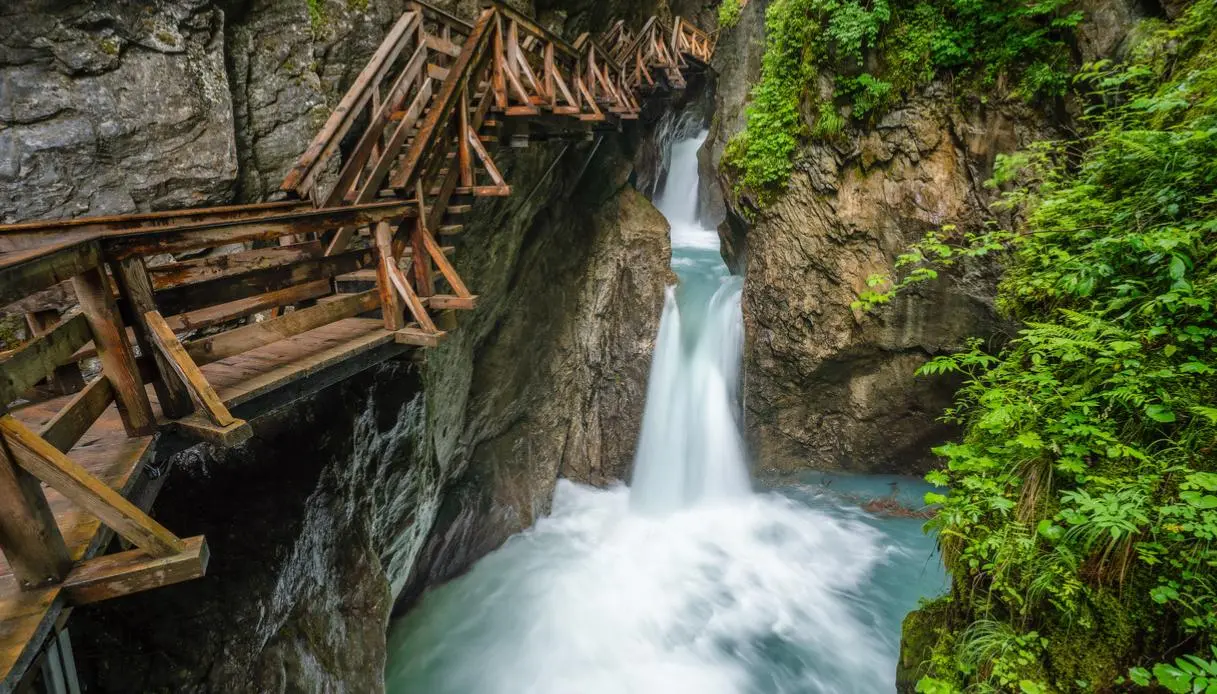
The first memory you take home from the Sigmund Thun Gorge is often a sound. Yes, because even before you clearly distinguish the rock walls, comes the roar of the Kapruner Ache, the torrent that cuts through it with impressive force. Water descends from the mountains and glaciers of the upper Kaprun valley, threads between the rocks and plunges in a succession of rapids, cascades, whirlpools, and pools.
Sigmund Thun Klamm is the German name of this narrow Alpine gorge, one of the most distinctive natural attractions in this part of Salzburg. One section lets light filter through the trees, the next narrows between tall rock walls. The Kapruner Ache appears at times like a white, foamy ribbon, then gathers again into small green-blue basins. In spring the torrent swells its flow thanks to the snowmelt from the mountains, and its action on the rock becomes even more evident.
The peculiarity of Sigmund Thun lies precisely in its dynamic nature: the water has smoothed surfaces, deepened cavities, and carved out new small basins. We are therefore talking about an environment still subjected to the force of the elements.
Origins and Formation of Sigmund Thun Klamm
Thousands of years ago, large ice masses covered the Kaprun valley in Austria. The subsequent retreat of the glaciers left space for the action of watercourses, among them the Kapruner Ache, which continued to carve the rock along its course. The result is a narrow natural incision about 320 meters long, with walls shaped by erosion and a drop that makes the water’s passage particularly spectacular.
However, the gorge also guards a human history far older than alpine tourism: the nearby Bürgkogel, a height located at the end of the Kaprun valley, was inhabited as early as around 4,000 years ago, during the Bronze Age. The presence of copper deposits in the region attracted the first communities, interested in the mineral resources of the area.
Centuries later the relief also assumed a defensive function. On Bürgkogel, fortified structures from the Celtic era have indeed been identified, and later remains of late antique fortifications. In the Middle Ages a fortress was built, regarded as a precursor of the current Kaprun Castle.
For centuries the forest heritage represented a fundamental resource and the Sigmund Thun Gorge was used for the rafting of timber. Some marks incised in the rock and figures accompanied by annual numbers are linked precisely to the work of those involved in transporting the timber.
Tourism arrived much later thanks to Nikolaus Gaßner, who was commissioned to build a road between Zell am See and Mooserboden. The valley thus began to become a destination for travelers drawn to the alpine environment. In 1893 Gaßner had a wooden footbridge constructed inside the gorge, making it accessible to visitors. The name Sigmund Thun, however, derives from Count Sigmund von Thun, the Salzburg governor of the time, who was deeply moved by the torrent’s power during a visit.
The gorge was declared a natural monument in 1934. Four years later the footbridge was abandoned due to hydroelectric works in the valley. The story of Sigmund Thun Klamm seemed destined to end, but its touristic vocation would return a few decades later.
In 1991 the association VSF-Kaprun decided to reconstruct the route along the historic track. Works began in spring 1992 and by August of the same year it was once again welcoming visitors.
Visiting the Gorge: Boardwalks, Waterfalls, and the Klammsee
The visit follows a purpose-built wooden walkway between the walls of the gorge. Stairs and bridges allow you to move above the Kapruner Ache, with viewpoints very close to the stream. The total length of the section inside the gorge is about 320 meters, and the passage takes roughly 20-30 minutes (not including breaks).
The terrain features steps and wooden passages, so appropriate footwear is needed. The best time to visit depends a lot on the atmosphere you seek: in the morning it can offer more tranquility, and the contrast between the outside light and the shadier areas is particularly evocative. In summer there are also evening visits with scenic lighting.
The gorge remains closed in winter for safety reasons. At the end of the gorge, the narrow pass gives way to the Klammsee, a basin with clear waters located in the upper part of the canyon.
A short walk allows you to circle the Klammsee along a route with panels dedicated to the flora and fauna of the area. For a break there are seating areas and spaces for families.
Those who want to go further beyond the gorge can consider the Bürgkogelsteig, a hiking route that connects the Sigmund Thun Klamm area to Bürgkogel and the valley landscape. It is a more demanding trek than simply visiting the gorge and requires hiking boots and a certain mountain experience.
To add a historical component to the day, the Kaprun Museum deserves attention as well, housed inside a farmstead of around 400 years old. The structure allows visitors to learn more about the town’s history and that of the valley, completing the narrative started in the gorge and on Bürgkogel.
Where It Is Located and How to Get There
Sigmund Thun Klamm is located in Kaprun, in the state of Salzburg, western Austria. The area belongs to the Pinzgau region and lies near the mountainous region of the High Tauern. By car, from Zell am See you follow the B168 road toward Kaprun. Once you reach the town, continue along the Kesselfallstraße.
Travelers using public transport can take the regional line 660, which connects Zell am See and Kaprun. The stop indicated to reach the gorge is Tauernplatz. From there it takes about 10-15 minutes on foot to reach the entrance. A visit to Sigmund Thun Klamm doesn’t take long, but it leaves a feeling far longer than the actual duration of the route: in just 320 meters the gorge concentrates water, rock, historical memory, and alpine scenery.