
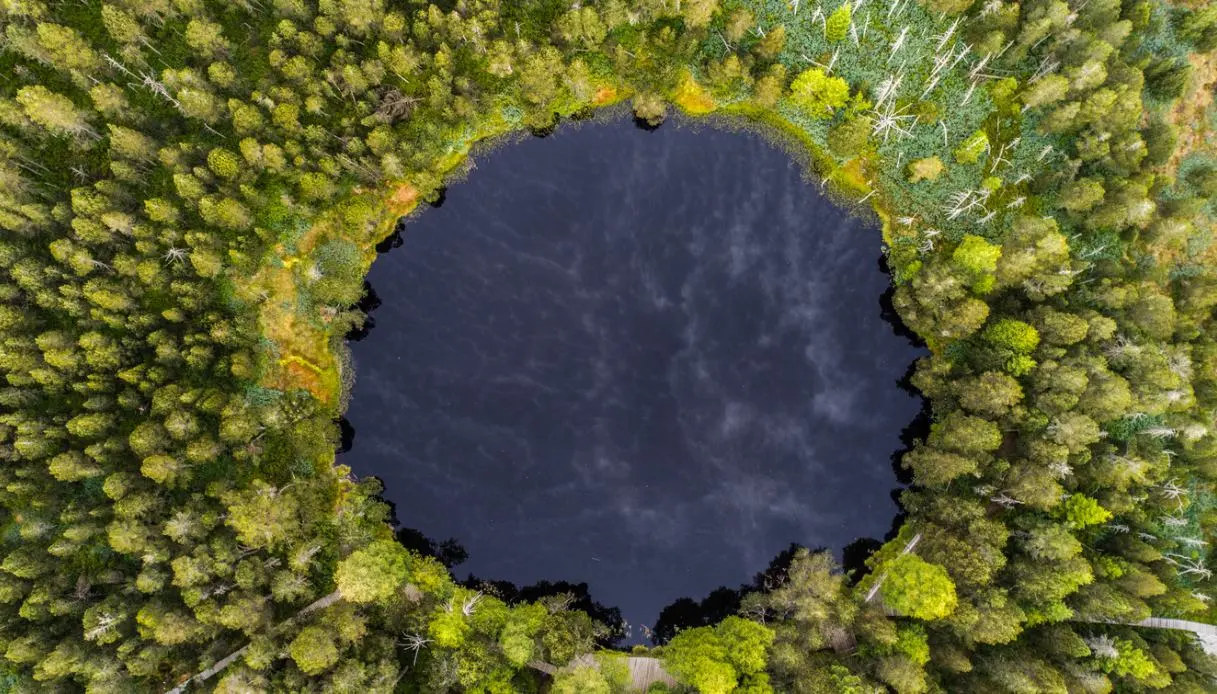
The initial glimpse of Blindensee arrives through a spread of low, damp vegetation, very different from the more familiar image of the Black Forest. Instead of a simple forest path, here there are wooden walkways, boggy ground, stunted and irregular pines, and vegetation composed of species typical of peatland environments.
At the center of this scene sits this small lake, located within a nature reserve, with a shape that is nearly perfectly circular and, above all, with a water color that immediately draws the eye: the surface is so dark as to give the basin a nearly black appearance.
The most surprising peculiarity, however, emerges when examining its structure, because Blindensee has neither an inflow nor an outflow. Its bottom is completely swampy and at a depth of 60 cm one can already glimpse a first layer of mud. From that point onward, solid ground is not reached.
Origin and formation of the Blindensee
Blindensee belongs to the category of high peat bog lakes. Around the water’s surface, a damp zone develops, characterized by swampy ground and a flora specific to these environments.
The vegetation tells a great deal about the character of the environment: among the species present are the eriophorum, the reeds, the sedges, the red cranberries, the centaury, the heather, and the sundew. The latter is a small carnivorous plant typical of several damp environments and makes the list of species in the reserve even more distinctive.
< /ask-ai-widget>
Glimpsing creeping pines and other low-lying forms of vegetation completes the landscape. Their appearance helps distinguish the lake’s area from the surrounding forest and creates a very distinctive frame for Blindensee’s dark surface.
The relationship between water and land also represents one of the most unusual characteristics. The peat bog reaches directly to the lake’s waters, and the bottom retains its swampy nature. At 60 cm a layer of mud already appears, with no reach to solid ground beyond that point.
The absence of an inflow and an outflow constitutes another peculiarity of the basin. No visible stream feeds the lake, and no watercourse collects its waters on the way out.
These elements explain much of Blindensee’s charm without the need for legendary stories, because its enigmatic character arises from the combination of ultra-dark water, peat bog, scarce vegetation, and the unique bottom structure.
Visiting Blindensee among boardwalks, nature, and silence
Visiting Blindensee means, above all, entering into contact with a delicate natural environment. The lake lies directly along the Westweg, one of the Black Forest’s hiking routes. Near the water’s edge, the trail crosses the nature reserve via wooden boardwalks.
The boardwalk becomes an integral part of the experience: beneath the planking lies the damp surface of the peat bog, while along the sides the area’s typical vegetation opens up. The lake gradually appears among the pines and the wetland plants, until revealing its distinctive almost-black surface.
Benches placed along the route allow visitors to pause. They are simple points, perfectly aligned with the character of the place. No large construction disrupts the landscape, keeping the focus on the natural environment.
What to see during the visit
- The lake itself: the nearly circular shape and the water’s deep, dark color are the most recognizable features of Blindensee. The surface seems particularly solid and deep to the eye, while the actual bottom structure is that of a peat bog.
- The peat bog: the damp ground surrounds the basin and constitutes a fundamental component of the nature reserve. Its presence directly influences the vegetation and makes the environment very different from that of a typical mountain lake.
- The rare flora: eriophorum, reeds, sedges, red cranberries, centaury, heaths, and sundews are part of the area’s vegetation. For botany lovers, the lake thus offers interest that goes well beyond the mere panorama.
- The creeping pines: the pine formations present in the damp area contribute to the landscape’s distinctive appearance. The low vegetation accompanies the path around the water.
- The wooden boardwalks: they constitute the most characteristic stretch of the route near the lake. They allow crossing the boggy area without directly stepping onto the swampy ground.
- The Westweg: a major hiking route that crosses the nature reserve and passes directly through the Blindensee area. The lake thus represents a stop embedded in a broader itinerary across the Black Forest’s highlands. On the Schönwald side, the Schönwälder Lieblingsplatz Blindensee has also been created, a new spot designed for resting and contemplating the landscape. Its presence adds another option to pause near the lake and enjoy the surrounding environment.
Where it is and how to get there
The enigmatic Blindensee lies in the Black Forest, in Germany, inside a nature reserve between Schönwald and Schonach, two towns high up in this mysterious forest. The main reference for reaching it is the Westweg, the trail that crosses the nature reserve and passes directly through the Blindensee area. Visiting the lake is thus tied more to the region’s hiking network than to a direct roadside access along the shore.
At the end of its discovery, one image remains above all: a small, almost circular, very dark surface, surrounded by rare plants and by a bog crossed by a wooden boardwalk. Around it, the Black Forest takes on a quieter, wilder face.
Blindensee is small, but its peculiarity lies precisely in the combination of elements that are difficult to encounter all at once. A lake without inflow or outflow, a bottom that becomes muddy at 60 cm, a peat bog rich in plant species, and a major hiking route that passes right through the reserve.