
Rome continues to surprise the world, even when you think you’ve seen it all. In the heart of the Colle Oppio, beneath the imposing Trajan’s Baths, a new museum space is about to open to the public, allowing visitors to literally descend below the surface of the city and discover a portion of the ancient complex that had long been inaccessible.
It is the fruit of the restoration and enhancement project carried out within the framework of the PNRR-Caput Mundi, which has made accessible again the Gallery and Esedra, permitting us to closely admire two important archaeological testimonies: the Painted City and the Great Mosaic. A new highlight has also emerged during the research activities.
It is a journey into the most hidden Rome, the one you do not see while strolling through its most famous streets and squares, but which reveals itself when you descend underground. Here, among frescoes, mosaics and ancient architectures, the history of the Baths of Trajan resurfaces to tell the city from a completely different perspective.
What lies beneath the Trajan Baths
Being able to explore the underground gallery means uncovering the most interesting archaeological stratifications of Colle Oppio. Investigations have allowed us to read the various phases of the area’s history, from structures predating the Baths of Trajan to the transformations that occurred in the following centuries.
Among the most evocative discoveries is the Painted City, a fresco of about 10 square meters dating to the 1st century AD, depicting a genuine fortified city, with walls, towers, buildings, a portico and even elements that resemble a theater and a harbor. The colors are still surprisingly legible, though it has not been possible to determine with certainty which city it represents.
Equally noteworthy is the Great Mosaic, a monumental decoration arranged in multiple registers, inside a chamber where a ninfeo and a scenae frons (or front façade, i.e. the monumental architectural front that closed the stage of Roman theatres) are located, with depictions such as statues, lifelike figures and the Musei.
During the area’s restoration a new portion of the mosaic also emerged, which seems to depict a port city: you can discern sea-facing buildings, perhaps seaside villas. Beneath are large marble slabs and a central niche about 2.20 meters tall.
To emphasize the significance of this discovery, the capital’s mayor Roberto Gualtieri stated, “we are aware that Rome adds a strong piece to its wonders.” He also noted that the two large decorative ensembles represent testimonies of particular importance “both from the perspective of artistic beauty and from the perspective of historical and documentary significance.”
The story of an extraordinary place
The Baths of Trajan were designed by the architect Apollodorus of Damascus and were inaugurated on June 22, AD 109. The complex covered about 60,000 square meters and was not intended solely for bathing: it included porticoes, green spaces, places for walking and physical activity, as well as areas connected to culture and sociability.
The area of today’s Colle Oppio park nevertheless preserves traces from even earlier eras. The structures unearthed underground have been connected by some scholars to the Domus Aurea, though the hypothesis is not considered certain. As explained by the Capitoline Superintendent of Cultural Heritage Claudio Parisi Presicce, “the thermal complex was an innovative model.”
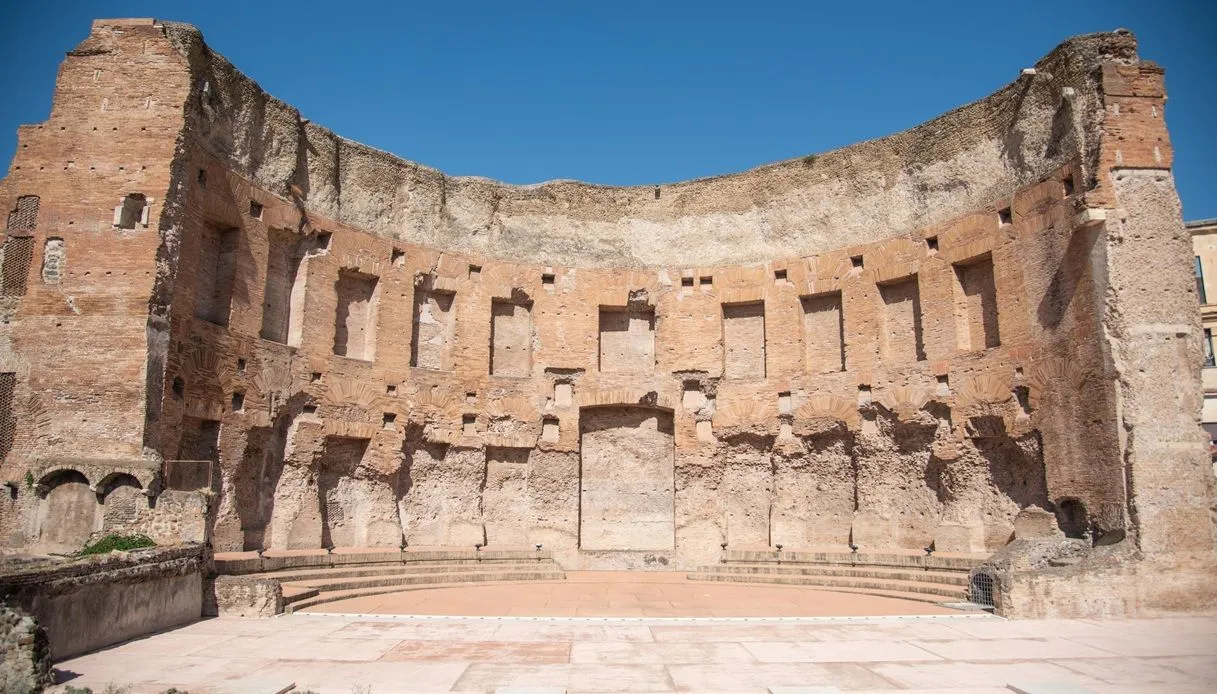
At the center of the new route also stands the imposing Esedra, a semicircular structure of about 30 meters in diameter. Its niches, arranged in two rows, may have been used to store documents or books, while the steps could have hosted readings and public gatherings. Today this space returns to life also as a venue for events, concerts and conferences, thanks to the new cavea.
The new visiting route was created through conservation and enhancement works that include the biocidal treatment of surfaces, the removal of deposits, consolidation and plastering, as well as the construction of new walkways, viewpoints and a lighting system. A footbridge also allows viewing the Great Mosaic from above, while another room hosts a collection of fistulae, the ancient lead pipes.
How to visit the new museum
Public opening will take place on a trial basis with free guided tours in Italian on Saturday 12 and Sunday 13 September 2026, by reservation and with a limited number of participants.
From 2 October 2026, however, the new space will be open from Friday to Sunday, with six daily shifts (at 10, 11, 12, 13, 14 and 15), for a maximum of 15 people per shift. Initially the tours are free, but later a ticket will be introduced: it will remain free for residents of Rome and of the 121 municipalities of the Metropolitan City.
Booking your visit is strongly recommended (please call 060608): the number of visitors has been deliberately limited to ensure a more attentive and immersive experience.