
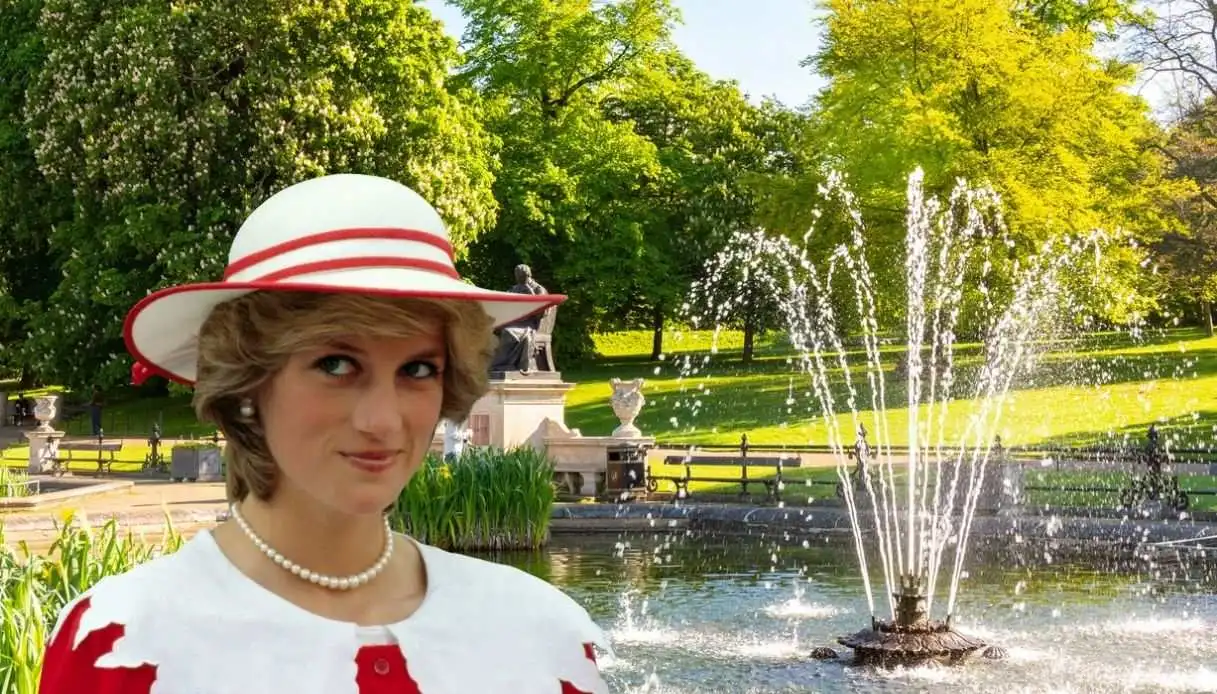
During her life, far too short, Princess Diana was the most famous and most photographed woman in the world. Loved by the people, often at odds with the rigidity of the Crown, Lady Diana managed to win the hearts of millions with her humanity, her fragility, and that rare ability for a royal to draw near to ordinary people.
Twenty-nine years have passed since her death, but the memory remains alive in the places that marked her life and in those that today safeguard her: from the palaces of royal London to the islands where she loved to retreat away from the spotlight.
Kensington Palace
It was her London home from her marriage to Charles in 1981 until her death in 1997. Here William and Harry grew up, and it is the place where Diana spent much of her life as a princess, between public moments and more intimate ones. Today the palace is open to the public with exhibitions dedicated to the Royal Family. The private apartments remain off the visitor route, but in the Sunken Garden of the Kensington Gardens you can view the official statue of Diana, unveiled in 2021 for her sixtieth birthday, surrounded by three children to symbolize her love for childhood.
After her death, millions of flowers from all over the world were laid at the palace gates, in one of the most intense acts of collective mourning ever seen in the United Kingdom.
Buckingham Palace
Heart of the monarchy, Buckingham Palace was the stage for hundreds of official ceremonies and state receptions in which Diana participated during her years as Princess of Wales, often bringing a touch of lightness to a highly formal setting. It was also here that, following her death in August 1997, thousands of people gathered spontaneously, leaving flowers, letters and candles: a popular tribute the United Kingdom had never seen on such a scale.
Diana Princess of Wales Memorial Walk
Those who wish to retrace Diana’s London at a leisurely pace can follow the official itinerary dedicated to her: the Diana Princess of Wales Memorial Walk, an approximately 11-kilometer circular walking route shaped like the figure eight, which passes through four of the city’s royal parks (Kensington Gardens, Hyde Park, Green Park and St James’s Park).
Along the way, ninety bronze plaques with a heraldic rose etched in the center guide visitors between five places connected to the princess’s life: Kensington Palace, Spencer House (the London home of her family), Buckingham Palace, St James’s Palace and Clarence House.
The path was inaugurated in 2000 by a committee chaired by Gordon Brown, who called it one of the world’s loveliest urban strolls, and it also includes the Diana Memorial Fountain in Hyde Park, making the entire loop a symbolic recap of her London story.
Hyde Park – Diana Memorial Fountain
Opened in 2004 by Queen Elizabeth II, the fountain was conceived with a simple and accessible design, capable of reflecting the princess’s open and approachable character. Water flows along two paths that meet at a single point, almost representing the happy moments and the more difficult ones of her life.
Even today many Londoners choose this corner of the park to pause for a moment, read a book, or simply remember her, far from the city’s hustle and bustle.
Althorp House
In Northamptonshire lies the historic residence of the Spencer family, where Diana spent part of her childhood and where she rests today. Inside the estate is the lake with the small island chosen by the family to ensure her privacy even after death, not accessible to the public. During opening periods it is however possible to visit the park and the museum that tell her life through photographs, personal belongings and historical documents: a stop that, for many, remains the most touching of all.
Balearic Islands
The royal summers also frequently took the family to the Balearic Islands. Charles and Diana were guests several times aboard King Juan Carlos’s yacht off Marivent Palace, where today Felipe and Letizia still enjoy spending holidays. Photos taken between 1986 and 1990 show them smiling with William, Harry, and the Spanish royal family. But Diana’s first encounter with that sea dates back to 1981, on her honeymoon aboard the Britannia.
British Virgin Islands
Diana also loved the British Caribbean, where she often returned to carve out a bit of privacy away from the limelight. In 1990 to Necker with her sister Sarah, the children and their mother, and in 1992 to Nevis with William and Harry, when the crisis with Charles was already public knowledge.
Necker Island is a private 74-hectare island bought by Richard Branson in 1979 and transformed into an exclusive resort, with white-sand beaches and coral reefs. Today it is rented in its entirety, with prices starting at several tens of thousands of euros per night. Nevis, a little further north, is a volcanic island of just 93 square kilometers that pairs with the nearby Saint Kitts. No traffic lights or shopping chains, but sugar cane plantations converted into boutique hotels and the ascent to the Nevis Peak for those who love trekking, all in a setting that remains authentic even in peak season.
Princess Diana Beach, Barbuda
The Caribbean also includes Barbuda, a small island where Diana loved to retreat to escape the paparazzi and the court life, in search of a little normality. It has been dedicated as the Princess Diana Beach, a stretch of pink sand colored by billions of tiny shells, formerly known as Access Beach.
Not a tourist hotspot, with almost all roads unpaved, Barbuda remains today an expensive destination even for William and Harry, who return there from time to time to rediscover a piece of their mother’s memory.