
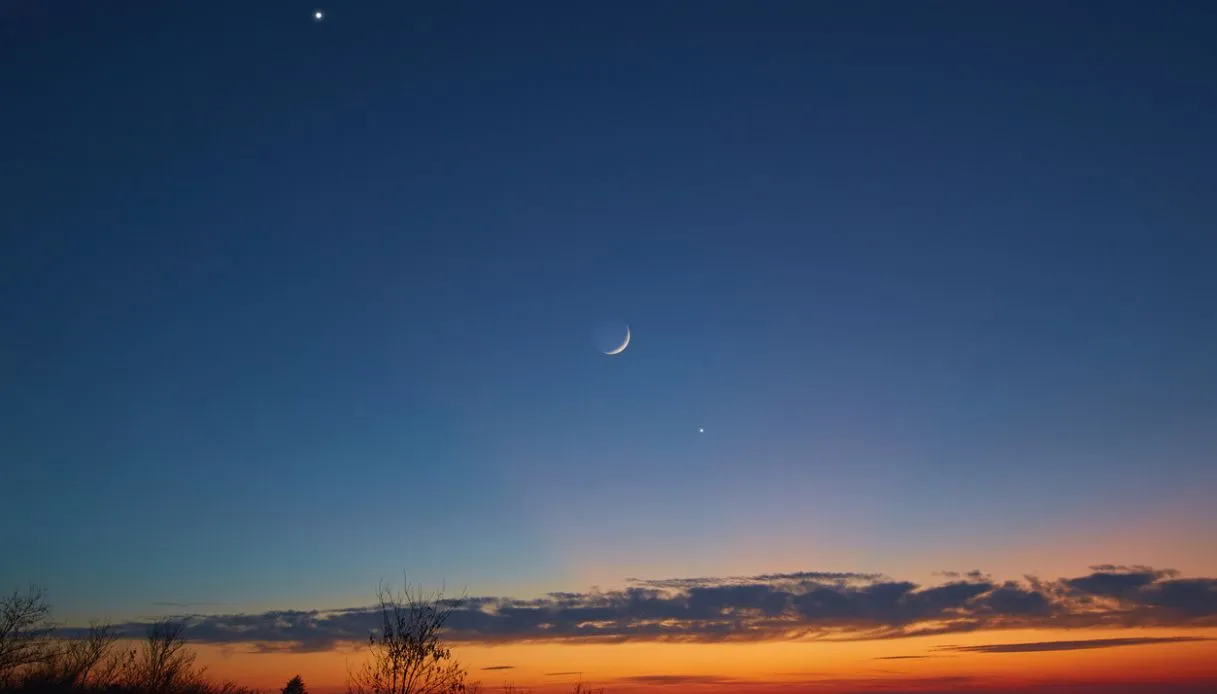
September is the month that guides the sky from the end of summer into autumn. The days grow shorter, the hours of darkness increase, and, just as the landscape changes, the sky above us changes as well. At typical Italian latitudes, over the course of the month about 1 hour and 21 minutes of daylight will disappear, making more room for astronomical observations.
Among shooting stars, close encounters between the Moon and planets, Neptune’s opposition, and the return of the autumn constellations, there are plenty of opportunities to spend a few evenings with your head turned upward.
September 19, Moon Night
One of the most anticipated events will be Saturday, September 19, when the International Moon Observation Night returns, promoted by NASA together with numerous partners and scientific organizations.
The initiative involves observatories, associations, museums, schools, and enthusiasts from all over the world, invited to observe our satellite and to take part in activities dedicated to science and lunar exploration.
The choice of date is not accidental. The event is usually organized near the first quarter, one of the most interesting phases for observing the details of the lunar surface. In this phase, along the terminator—the line that separates the illuminated portion from the shadowed part—the grazing light helps highlight craters, mountains, and other relief features.
New Moon and Full Moon
The New Moon will arrive on September 11, the first quarter will be on September 18, followed by the Full Moon on September 26.
Evenings around September 11 will be very promising for observing stars, meteors, and faint deep-sky objects. The near-total absence of moonlight will make the sky darker. At sunset on September 11, only about 0.5% of the lunar disk will be illuminated: the very thin crescent will be difficult to spot, gradually becoming more evident in the days that follow.
Meteor Showers, the September Epsilon Perseids
September cannot boast a spectacular meteor shower like the August Perseids, but in 2026 some minor meteor streams will still offer favorable observing conditions.
The September epsilon-Perseids are active roughly from September 5 to 21 and are expected to peak around September 9: the meteors reach a geocentric velocity of about 64 kilometers per second and, at the peak, the theoretical rate is about eight meteors per hour.
The maximum will arrive just two days before the New Moon, when lunar light pollution will be absent. According to the UAI, some models also indicate the possibility of encountering meteor material during the hours of September 10.
Moon and Planet Rendezvous
A little before dawn on September 8, a slender Moon crescent will be close to Jupiter.
Another alignment will occur in the evening of September 14, when the Moon and Venus meet in the western sky, amid the twilight. Finally, on September 27, the Moon, just past full, will appear near Saturn.
September 26, Neptune at Opposition
September 26 is an important date for Neptune, which will reach opposition. From an Earthly viewpoint, the planet will be opposite the Sun and can therefore be observed all night.
Near opposition, Neptune will also reach the closest distance to Earth of the year, about 4.32 billion kilometers. The great distance and its faint luminosity mean the planet is not visible to the naked eye.
Saturn, Venus, Mars, and Jupiter
Among the planets visible this month, Saturn will be a major highlight and will be visible for almost the entire night: it will rise in the eastern sky in the early evening and reach its greatest height toward the south in the middle of the night.
As noted, it will be even easier to spot on September 27, when it will appear near the Moon, now just past full.
For Venus, September marks the tail end of a long period of evening visibility. The planet will appear progressively lower on the western horizon and by the end of the month it will set less than an hour after the Sun. Those who prefer pre-dawn observing can instead look for Mars and Jupiter toward the east: Mars will rise in the latter part of the night, while Jupiter will be visible closer to the horizon.
September: the Month to Seek Andromeda and More
In the early evening, some of the summer constellations will still be visible: the Summer Triangle, formed by the stars Vega, Altair, and Deneb, will slowly move toward the west. To the southeast, the Great Square of Pegasus will emerge more prominently, from which it is possible to locate the constellation of Andromeda, even with a simple binocular, and under skies free from light pollution, it can be seen with the naked eye. It is the nearest spiral galaxy to the Milky Way, and its light takes about 2.5 million years to reach us.
In the early evening, finally, the horizon will still reveal the Scorpius, followed by the Sagittarius, and, higher up, Ophiuchus and Hercules. To the northwest, the star Arcturus, belonging to the constellation Boötes, will be setting.