
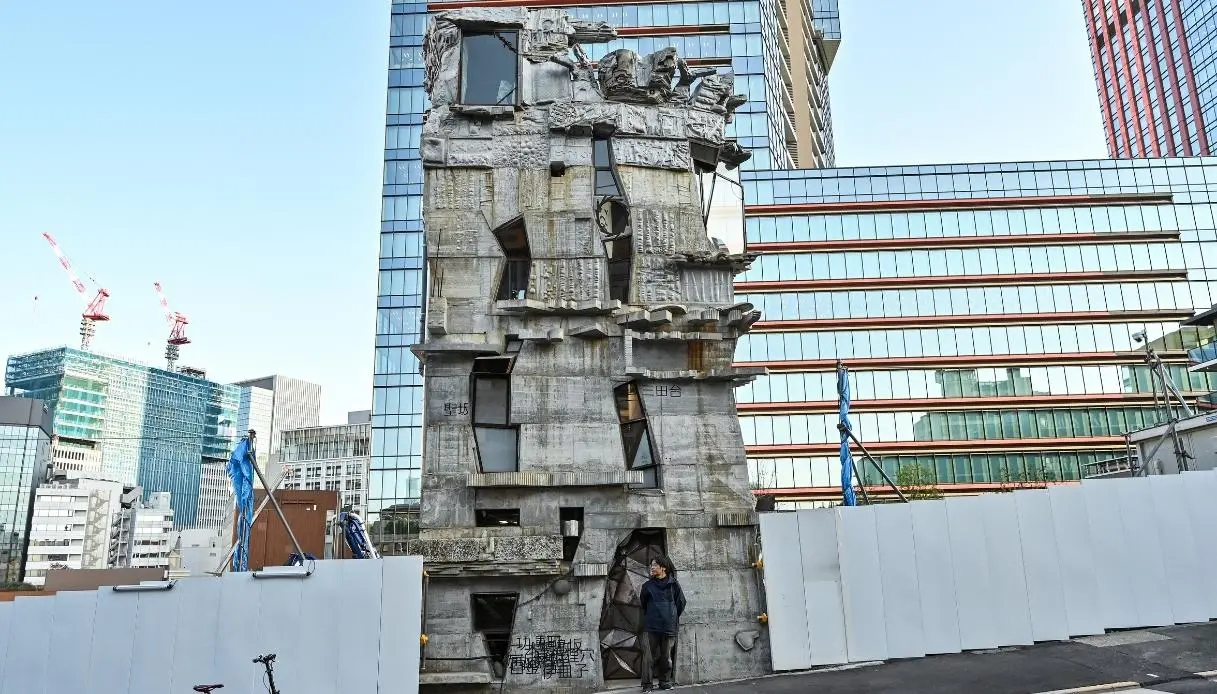
If there is a frenetic city where buildings sprout, vanish, and transform within a single generation, that is surely Tokyo, but among all the constructions one has etched something that has never happened before. The Arimaston Building, which has been nicknamed “the Japanese Sagrada Familia,” did not end up beneath the bulldozers; in 2025 it was relocated, lifted (foundations included) and moved about 10 meters away. The Japanese technique called hikiya has made this place famous worldwide.
Arimaston Building, the Sagrada Familia of Tokyo
The Arimaston Building responds to the obsession of architect Keisuke Oka, who for twenty years has been shaping the building while allowing it to change its form over time. The result is something quirky and, more than a mere palace, a sculpture in which to live, complete with irregularities, material contrasts, and a heartbeat that seems alive. The structure is among the most distinctive in the Mita district and, with its own tempo, it reshapes Tokyo’s landscape.
The reference to Gaudí does not arise from an aesthetic likeness. The forms are different, the languages distant. What links Barcelona and Tokyo is rather the relationship with time: that of a work that grows slowly, spans the years, and rejects the idea of an imposed end.
The construction site thus becomes part of the architecture, almost its most authentic form. It isn’t only the day when everything will be finished that matters, but every gesture, every addition, every transformation that continues to breathe life into the building. As if building, in the end, were already the goal. Oka began working on the Arimaston in 2005 and has never stopped.
The Japanese name of the building sounds almost invented and combines the characters for ant, trout, and buzzard; while it does not have a clearly defined meaning, Oka’s idea was to evoke the animal world so that the name could be as strange as the building itself.
What strikes about the Arimaston is not so much the outcome as the method. Oka built much of the building by himself, mixing and transporting concrete by hand, without heavy machinery or a fixed plan to follow. Over time he rewrote portions of the structure, adding and adjusting them as the project grew.
The irregularities that characterize the surfaces are studied just as the non-symmetric curves and the openings that cut the facade diagonally. In a recent interview, Oka himself toned down the myth of the solitary genius, explaining that his imagination is limited and he is grateful for the collaborations with others who, in a practical sense, have helped him open new doors.
Location and How to Reach It
The Arimaston Building is located in the Mita district of Tokyo, in a busy area filled with buildings and life within the Minato ward. To reach and see the “Japanese Sagrada Familia” in person, use Mita Station as a reference point, reachable via the Toei Asakusa and Toei Mita lines. Walking up Hijirizaka quickly leads you there; alternatively, you can use Tamachi and Akabanebashi stations and continue on foot for a short stroll.