
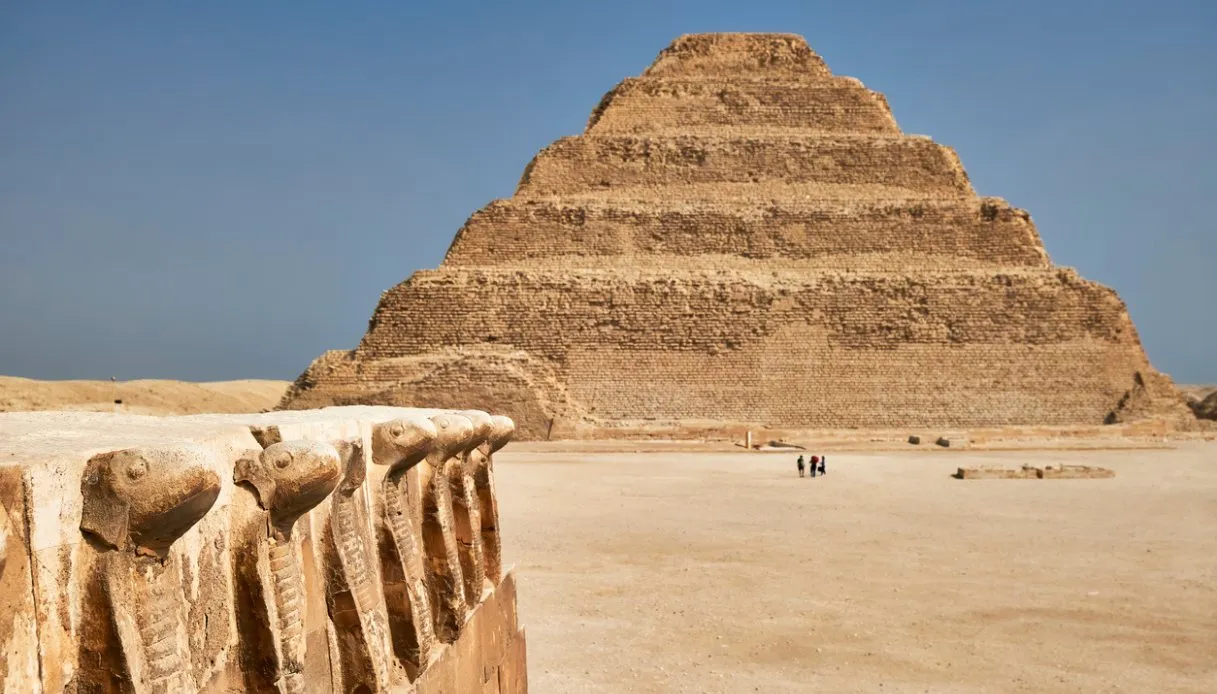
Over four thousand years ago, in the era when Egypt was building its pyramids, a man of enormous political influence named Sekhentiu-Ptah, a high official of the Old Kingdom and Keeper of the Pharaoh’s Secrets, died and was buried in the vast royal necropolis that today stretches across the desert to the west of Cairo. His tomb, with the false doorway still in its original place, has recently resurfaced in the Saqqara archaeological area, in the Bubasteum necropolis zone.
Discovery of the Tomb of the Keeper of the Pharaoh’s Secrets
In the burial chamber, archaeologists led by Dr. Amr el Tayeb uncovered, right in front of the false door, a cremation of alabaster equipment entirely composed of alabaster: an offering table, a ceremonial disk, a basin for purification rites, together with a jar and a bowl. On each piece appear hieroglyphic inscriptions bearing the name and titles of the deceased.
It is precisely these inscriptions that reveal the profile of a man of enormous political weight: Sekhentiu-Ptah held positions such as Royal Cupbearer, Overseer of the Works of the Sovereign, and Overseer of the Royal Documents, in addition to the title that gives the discovery its name, Keeper of the Secrets of the Royal Decrees. He also held religious roles, as a priest dedicated to the goddess Ma’at, and administrative roles, such as Overseer of the Scribes. A résumé that places him among the top tiers of the Old Kingdom bureaucracy, in close contact with the pharaoh.
Around his tomb, excavations have also revealed a dense network of interconnected burial pits, reused almost two millennia later, during the Late Period (7th–4th century BCE). From these pits emerged three stone sarcophagi still sealed, along with more than a hundred faience ushabti figurines and large quantities of painted cartonnage, the papyrus-like material used to cover mummies, derived from linen and papyrus.
Why this is an important discovery
The value of the Saqqara discovery rests primarily in the burial set of Sekhentiu-Ptah, which, with its inscriptions, allows archaeologists to reconstruct in detail his titles and his role at the apex of the Old Kingdom administration, providing a tangible piece of the power hierarchy surrounding the pharaoh in that era.
In addition to this, the broader complex holds significant archaeological value despite the alterations it has suffered: some tomb chambers show openings made by tomb robbers in ancient times, indicating looting that occurred well before the arrival of modern archaeologists. Nevertheless, scholars emphasize the archaeological value of the site, which the stratigraphic, architectural, photographic, and digital documentation will now enable researchers to analyze more deeply, alongside ongoing archaeological, linguistic, and comparative studies.
The mission will continue with the study of the recovered materials, with the aim of publishing in specialized scientific journals. Archaeologists also believe that the investigations may reveal further structures and artifacts, contributing to reconstructing the history of the Bubasteum necropolis through its various phases of use.