
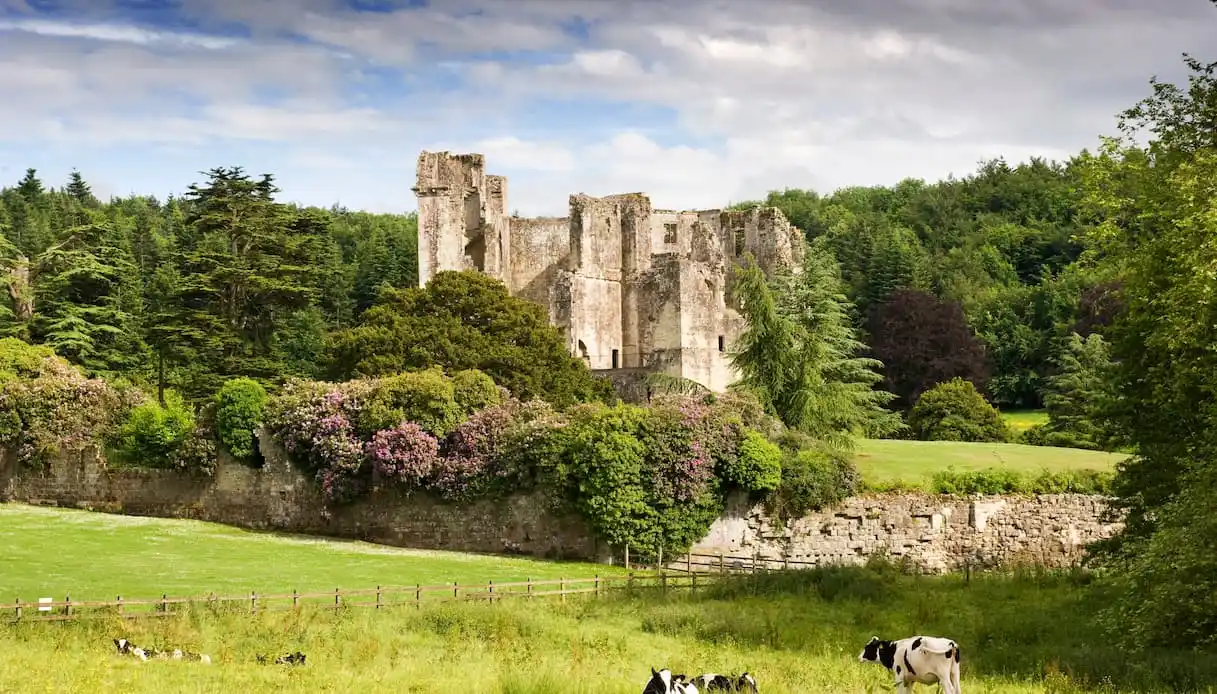
If you were a child or teenager in the Nineties, you’ll probably remember the forests of medieval England, the battles with bows and arrows, and Kevin Costner in the role of the rebellious hero of Sherwood in Robin Hood – Prince of Thieves. Among the locations that helped create that epic atmosphere is also a real place that can be visited today: Old Wardour Castle, one of the most fascinating and unusual castles in Wiltshire.
What on the big screen resembled a fortress sprung from legend is in fact an extraordinary medieval ruin with a history spanning more than six centuries. Erected in the fourteenth century, the castle stands out for its distinctive six-sided plan, a truly rare architectural feature in England, and for its past marked by noble families, sieges, and transformations.
Once the residence of the Lovell family and later of the Arundells, Old Wardour Castle was modernized in the Tudor era and became the centerpiece of some of the most eventful chapters of the English Civil War. Today its walls shelter period rooms, a panoramic tower, a romantic Georgian banqueting house, and even a curious Gothic cave decorated with ancient prehistoric stones recovered from the surrounding area.
What to See and Do at Old Wardour Castle
Strolling among the walls of Old Wardour Castle feels like retracing more than six centuries of history in a single visit, weaving medieval architecture with lake views and corners that seem straight out of a fairy tale. The first thing that catches the eye is the castle’s unusual hexagonal shape, a rare architectural design in England. During the Tudor period, the Arundell family modernized part of the building: on the entrance facade you can still observe their heraldic coat of arms.
Among the most spectacular spaces is the Great Hall, once the ceremonial reception room where the lord of the castle hosted the most illustrious guests. Even today you can admire the elegant Gothic windows, the carved decorations, and the architectural elements of the era. One of the most evocative experiences is the ascent along the eastern tower. The ancient stone steps lead to the upper floors, where you can still observe fireplaces, medieval latrines and remnants of the original rooms. From the summit, moreover, there is a panoramic view of the lake, the surrounding meadows, and the Wiltshire countryside.
While wandering the walls, you can notice numerous stone-carved details. Above the main entrance there is a Christ bust that once reflected sunlight, while in the ancient wine cellars you’ll find stone vaults, fireplaces and decorations bearing lion heads. Among the most curious buildings in the complex is also the Banqueting House, built in the eighteenth century on the lakeside. With its Gothic battlements and stained-glass windows, it was used as a rest stop for visitors arriving at the castle during the Georgian era. Inside today there is a small exhibition dedicated to the history of landscaped gardens, while from the outside you can enjoy one of the finest views of the entire complex. Not far away is the scenographic Grotto, an artificial fantasy-Gothic cave created using even ancient prehistoric monoliths recovered from the surrounding area.
To truly understand the castle’s past, it is worthwhile to use the free on-site audio guide. Among the most moving episodes is the story of Lady Blanche Arundell, who during the English Civil War managed to defend the castle for an entire week with just 25 men and her ladies-in-waiting against Parliamentarian troops. A few months later the stronghold was captured and badly damaged during a second siege.
Old Wardour Castle is also an ideal destination for families traveling with children. The younger visitors can take part in the interactive game “Can You Keep Your Castle?”, which lets them discover the castle’s history through puzzles and missions, or follow the Folktale Creature Trail, a route dedicated to the legendary creatures of English folklore with a final certificate.
Where It Is Located and How to Reach It
Old Wardour Castle lies near the village of Tisbury, in the county of Wiltshire, in the southwest of England, about an hour’s drive from Bath and Salisbury. The castle is easily reachable by car and provides visitor parking. Those using public transport can arrive by train to Tisbury station, connected to London and Salisbury, then continue by taxi for a few kilometers.
The entrance is managed by English Heritage and booking online the day before yields a discount on the ticket, while members can enter for free. The castle is generally open every day from 10:00 to 17:00, with day-long tickets that allow visitors to explore the site without time limits during opening hours.