
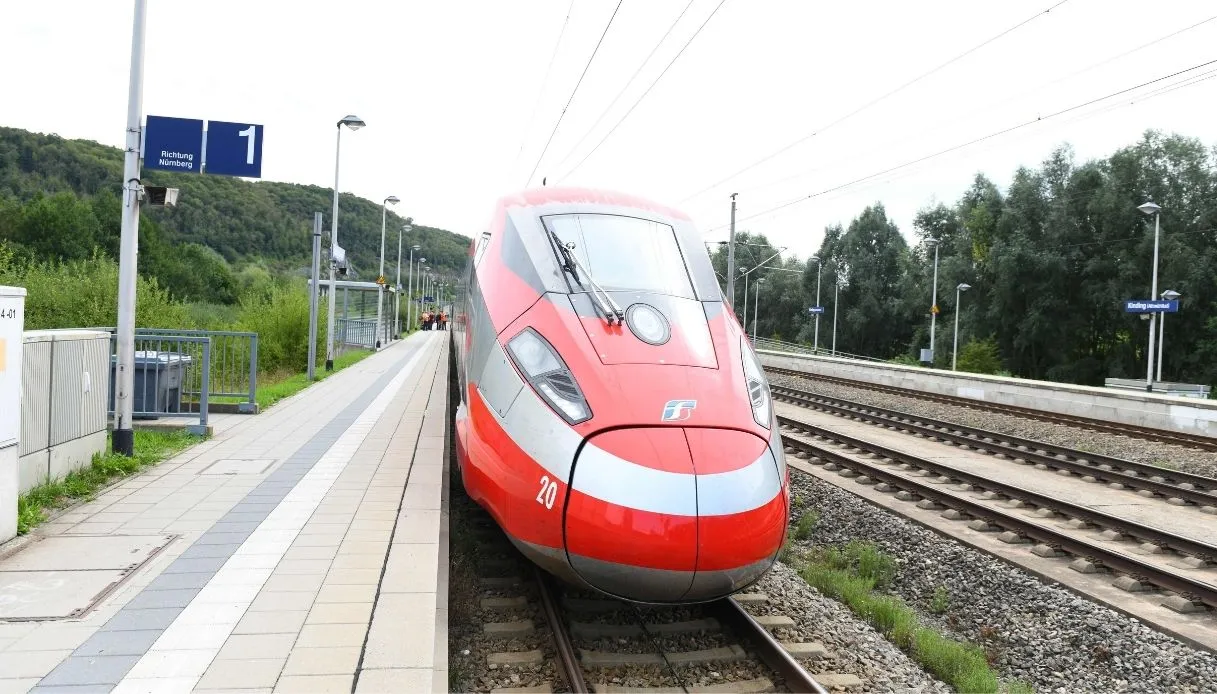
Frecciarossa is preparing to cross the Alps. Trenitalia, together with Deutsche Bahn and ÖBB, has launched in Germany and Austria the initial test runs necessary to obtain homologation for the trains. It is one of the essential steps toward the debut of international connections, expected for the summer of 2027. The first direct services should connect Milan to Munich and Rome with the Bavarian capital. The tests will verify the compatibility of Italian trains with the German and Austrian railway networks, before final authorization for commercial operation.
From Rome and Milan to Munich with Frecciarossa
Track tests have begun for the project that will bring the Frecciarossa from Milan and Rome to Munich. The debut of direct connections remains slated for the summer of 2027. The trains used in the tests have been equipped with specialized instruments to verify compatibility with the different networks traversed. In Germany, the test runs focus on the Berlin-Munich-Kufstein axis.
Tests also in Austria, where the Frecciarossa is travelling between Kufstein and the Brenner Pass and on the Salzburg-Vienna route. A decisive technical phase before moving to commercial operation.
The route and duration
The commercial program will offer from Milan a journey of about 6 hours and a half to reach Munich, with stops including Brescia, Verona, Rovereto, Trento, Bolzano and Innsbruck before actually arriving in Germany. From Rome, it will require 8 hours and a half with intermediate stops at Florence, Bologna, Verona, Rovereto, Trento, Bolzano and Innsbruck.
Thanks to the opening of the Brenner Base Tunnel, the travel time will be reduced by one hour. The expansion plan will not stop there: starting from December 2028 there could be up to 10 connections between Italy and Germany, adding the Naples departure and even reaching Berlin.
Gianpiero Strisciuglio, Chief Executive Officer and General Manager of the FS Group, said: “The launch of trial runs in Germany and Austria is a step toward the realization of a project that confirms our ambition to make the train the reference mobility option for European transport. Thanks to the collaboration with Deutsche Bahn and ÖBB, we move toward the realization of the ‘Europe’s Metro’ high-speed network, offering passengers a service capable of bringing territories, people and economies closer. Frecciarossa thus continues its path of international growth, bringing abroad the technological and industrial excellence of the FS Group and contributing to the development of an increasingly integrated European railway network.”
New trains for the Italy-Germany route
The testing phase requires some modifications to be able to manage the electrical power supply systems that vary from one country to another; for this reason a technical collaboration between Trenitalia, Deutsche Bahn and ÖBB has been established with the aim of speeding up the process and finding technological solutions capable of making Frecciarossa usable on the German and Austrian infrastructures. Parallel to the preparation of the prototypes, training programs for drivers and railway staff in Germany and Austria have also begun.
The arrival of Italian high-speed to Germany is a symbol of Trenitalia’s expansion plan after already signing important collaborations with France and Spain; the project aims to deliver ever faster connections, thus offering a greener alternative to air travel by arriving directly in city centers, avoiding the inconvenience of airports that are often located about an hour away from the destinations.