
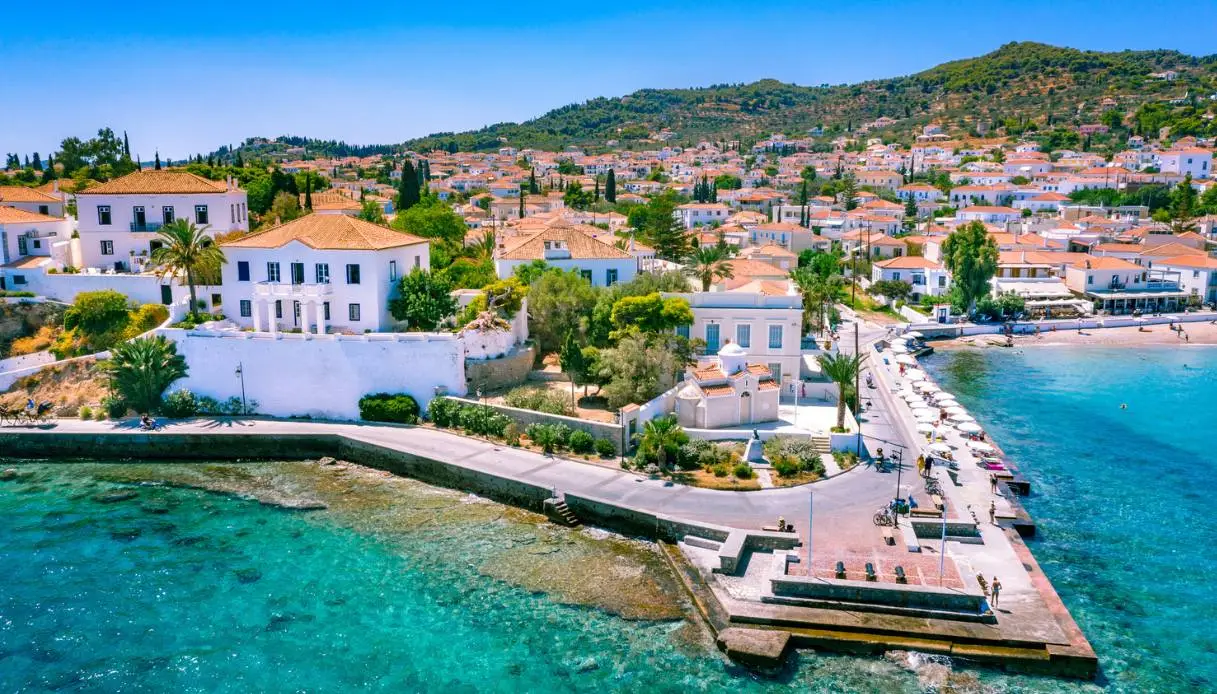
You leave behind (and thankfully, one might say) the clamor of Athens as you board a ferry. Then, almost like a mirage, a harbor appears, giving the sense that you’ve changed rhythm even before stepping ashore. We’ve arrived at Spetses (in Italian Velvina), an island where the sea has built fortunes, war has transformed shipowners into heroes, and contemporary taste has added boutiques, carefully curated restaurants, and gleaming yachts.
Italians might call it the Forte dei Marmi of the Saronic Islands, a somewhat irreverent but very apt comparison. Spetses is indeed the exclusive island of the Argosaronic, frequented by a well-to-do Greek bourgeoisie who come here whenever they can, especially on summer weekends.
Yet, as soon as you move away from the harbor, the story takes a different turn: the hills are cloaked in pines, the coastal road winds around them for about 24 km, and the scent of resin mingles with the brackish air. There is history here too, indeed it goes back quite far with settlements already in the Mycenaean era, around 2000 BC. Then come the navigators, the great shipowners, the captains’ homes, and the Greek Revolution of 1821. Spetses leaves its mark because, yes, it’s elegant, but also (and above all) with hands still stained by pitch and wood.
What to See in Spetses
The first surprise of Spetses is how history meets you without needing to search for it too hard. A plaque, a façade, a cobblestoned courtyard, and suddenly the past stops being something you have to hunt down.
Dapia and the seafront up to the Old Port
Dapia is the main harbor and the right starting point to gauge the island. The promenade begins at the Poseidonion Grand Hotel, opened in 1914 and still today a symbol of local elegance. Its architecture recalls the grand European aristocratic hotels, and its position facing the harbor clarifies well the role it has played in Spetses’ collective imagination.
The street continues between cafés, neoclassical buildings, and the ancient kapetanospita, the captains’ houses. They are imposing residences, built by families enriched through navigation, with well-kept façades and interiors once filled with precious woods, embroidery, and imported furniture. Toward the Old Port the landscape changes. Baltiza is the island’s maritime heart, and the karnagia, the traditional shipyards, still preserve the handmade construction of wooden boats.
The Church of Agios Nikolaos and the bell tower of the Revolution
In 1821, the bell tower of the Church of Agios Nikolaos was linked to Spetses’ participation in the Revolution against the Ottomans. And this deserves careful attention, as does the monument to the fallen. Equally beautiful is the courtyard that shelters splendid votsalota, mosaics crafted from pebbles laid out in decorative patterns.
The Laskarina Bouboulina House-Museum
Here history has a formidable protagonist: Laskarina Bouboulina was born in an era when military and political power belonged almost exclusively to men. She commanded a fleet, funded the revolutionary cause with her own wealth, and took part in naval operations against the Ottomans.
Her house is today a museum, and the guided tour lasts about 40 minutes. The spaces house furniture, letters, weapons, and personal belongings. The most striking detail remains the carved ceiling of the salon, a refined decoration inside the home of a woman who, at sea, commanded a warship.
The Spetses Museum in the Hatzigiannis Mexis Residence
The Spetses Museum occupies the residence of Hatzigiannis Mexis, a shipowner and figure of the Revolution, later the island’s first governor in the new Greek state. The collection spans roughly 4,000 years of history, including Mycenaean ceramics, Roman coins, Byzantine icons, costumes, and artifacts tied to the War of Independence.
The Old Port, Baltiza and the lighthouse
Then the Old Port, the island’s most theatrical district. Yachts fill the water, the old shipyards preserve the memory of shipbuilding, and the peninsula leads toward the lighthouse. Along the way you encounter the bronze sculptures by Natalia Mela, mixing animals and mythical creatures. At sunset the lighthouse offers one of the most beautiful moments of the entire stay.
Kasteli and Kounoupitsa
Kasteli rises above the port and is the cradle of one of the island’s oldest churches, the Dormition of the Virgin Mary, with a position that affords a broad view over the town and the sea. Kounoupitsa, for its part, has a more residential atmosphere, with neoclassical buildings and well-tended gardens.
The Bekiris Cave and the island’s trails
The Bekiris Cave is on the southwest coast, near Agii Anargiri. During Ottoman rule it was used as a shelter for women and children. It can be reached also from the sea, and inside there is a small beach. For those wanting to explore the inland, the Greek Cultural Trails bring together 19 routes totaling about 65 km.
The most beautiful beaches of Spetses
The beaches of this Greek island feature clear waters, pebbles, coarse sand, and pine forests often very close to the shore. Some bays are equipped, others keep a more secluded atmosphere.
- Agia Paraskevi: among the most picturesque. The small church and the pines almost leaning into the sea create a postcard landscape, with pebbles and transparent water;
- Agii Anargiri: the largest on the island and has sunbeds, a tavern, and facilities for water sports;
- Zogeria: here the pine forest reaches nearly to the shore and the water has that transparency inviting you to stay in silence;
- Vrellos: alternates sand and pebbles, with pines behind and a more intimate scale than the main beaches;
- Agia Marina: located a short distance from the Old Port and equipped with sunbeds, parasols, bars and water activities;
- Ligoneri: also known as Kaiki, is close to the town and has a younger vibe.
Where It Is Located and How to Arrive
Spetses lies in the Argosaronic Gulf, off the southern coast of Argolis and near the Peloponnese. It is the southernmost island in the Argosaronic group and administratively belongs to Attica, though it has a very strong geographic tie to the Peloponnese. From Piraeus, fast ferries and conventional connections depart. The journey lasts about 1 hour and 45 minutes on the swift services, while traditional runs take longer.
For those coming from the Peloponnese, the most practical option is Porto Heli or Kosta. From the latter, the boat crossing lasts nearly 15 minutes. It’s important to know that traffic on Spetses is heavily restricted. The car therefore stays on the mainland, as people get around here with scooters, bicycles, taxis, and the traditional horse-drawn carriages.
The advice is simple: Spetses deserves more than a day, but it should be planned with at least a bit of strategy. A summer weekend can turn it into a crowded little catwalk. A few midweek days, on the other hand, reveal a more authentic island. Its uniqueness, in fact, lies in the fact that it has learned to be chic without erasing its own history.
