
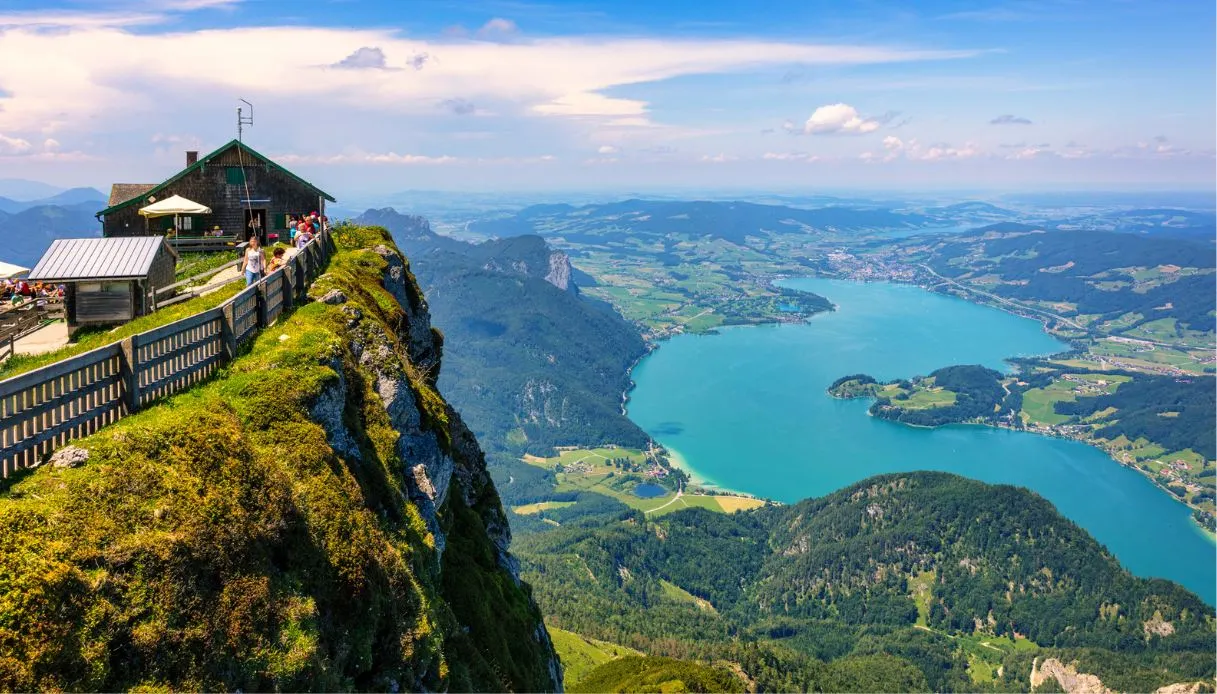
Clear water, green mountains, and a grand limestone cliff that seems to plunge straight into the scenery. In the background, there is Drachenwand, the “Dragon’s Wall,” a rock formation so scenographic that it has become the emblem of Mondsee. After all, the summit reaches 1,176 metres and on the lake-facing side there rises an almost vertical cliff about 700 metres high.
Mondsee belongs to the Salzkammergut, a vast lake region in northern Austria famed for the mixture of waters, mountains, forests, and small historic towns. The lake covers about 14.2 km², reaches a maximum depth of 68 metres, and stretches for nearly 11 km, with a width that can be around 2 km. The southwest shore also marks the border between Upper Austria and Salzburg.
The lake is also one of Austria’s great paradises for water activities. Its waters reach temperatures close to 27 °C in summer and allow swimming, sailing, windsurfing, stand‑up paddleboarding, waterskiing, wakeboarding, and kitesurfing. For those who prefer to stay on dry land, the area offers hiking trails and cycling routes among the Mondseeland hills. The name itself literally means “Moon Lake,” and local tradition ties this designation to the moonlight reflected on the waters.
Origin, formation and legends of the Moon Lake
The history of Mondsee runs much further back than the birth of modern lake tourism. The basin belongs to a landscape shaped by the great Alpine glaciations. The action of the ice carved and deepened numerous valleys in the Salzkammergut, leaving behind a sequence of depressions filled with water. Mondsee is part of this large glacial-origin system, together with many basins that characterize the region.
Human presence on its shores dates back at least to the Neolithic. In the 19th century traces of ancient settlements were identified, giving rise to studies on the Mondsee culture, one of the most important prehistoric archaeological realities in Central Europe. This culture is generally placed between roughly 3000 and 2200 BC.
< /ask-ai-widget>
The archaeological heritage tied to the lake is particularly precious because certain environmental conditions favored the preservation of organic materials. Remains of dwellings, tools, ceramics, and items connected to daily life have allowed researchers to reconstruct agricultural, artisanal, and dietary activities of the communities that lived along the basin’s shores thousands of years ago.
The pile-dwelling sites of the area belong to the UNESCO’s Prehistoric Pile Dwellings around the Alps, a transnational network that encompasses 111 localities spread across 6 countries.
The legend attached to the name adds another layer to its story: according to tradition, the Bavarian duke Odilo was in the area during a hunting excursion when night fell. The full moon would illuminate the lake and point the duke to a path of salvation. From this episode would come the decision to found a monastery on the shores of the basin in the 8th century.
A second legend concerns directly the great wall that dominates the lake. In the Drachenwand opens the Drachenloch, a natural cavity of about 8 metres in diameter. Local folklore attributes the formation of the passage to the devil, imagining him crossing the mountain in flight after abducting the parish priest’s cook.
Things to do and see on Mondsee Lake
A boat trip lets you appreciate the shape of the basin and, above all, view the Drachenwand from the most spectacular vantage. From the surface, the relationship between the rocky wall and the lake becomes more evident, while the Drachenloch becomes recognizable in the mountain’s silhouette.
The summer temperatures, which can reach about 27 °C, make Mondsee especially suitable for swimming. The shores host facilities and public areas equipped with lawns for sunbathing, family spaces, and services dedicated to water activities.
The elongated form of the lake and the favorable conditions have turned Mondsee into a destination appreciated by sailors. Local nautical schools offer courses and boat rentals, allowing even beginners to try sailing.
There are plenty of chances to engage in water activities such as SUP, which involves standing on a board and propelling yourself with a paddle. Windsurfing, wakeboarding, and waterskiing demand more technique. Kitesurf adds an even more spectacular element, thanks to the wind on the kite that enables acceleration and short jumps on the surface.
A day on the lake lets you reach the most evocative viewpoint of the wall. From below, the mountain appears enormous and solid, with the green of the forests interrupted by the limestone rocks. The Drachenloch becomes particularly striking from this perspective.
For those who prefer a relaxed day, Mondsee offers meadows, beaches, and bathing areas dotted around the basin. A towel, a book, and a few hours by the water are enough to enjoy the landscape without following a strict plan.
Where it is and how to get there
Lake Mondsee is located in Upper Austria, in the Salzkammergut, not far from the border with Sachseburg—I mean, Salzburg. Its position makes the basin easily reachable from Salzburg, about 30 km away, and is one of the reasons for its popularity even for short stays.
By car, the main reference is the A1 motorway, which links Vienna, Linz, and Salzburg. The Mondsee exit takes you directly toward the lake and the town on the northern shore. Salzburg constitutes the most convenient airport for those arriving by air. From the city you can continue by car or use direct regional connections toward Mondsee. The area is also served by public transportation, a solution interesting for those who want to reach the lake without using a car.
Once on the shores, the landscape makes clear immediately why Mondsee earned this name: clear water, mountains, limestone cliffs, and the lunar light reflected on the surface compose an environment where the natural dimension remains the protagonist.