
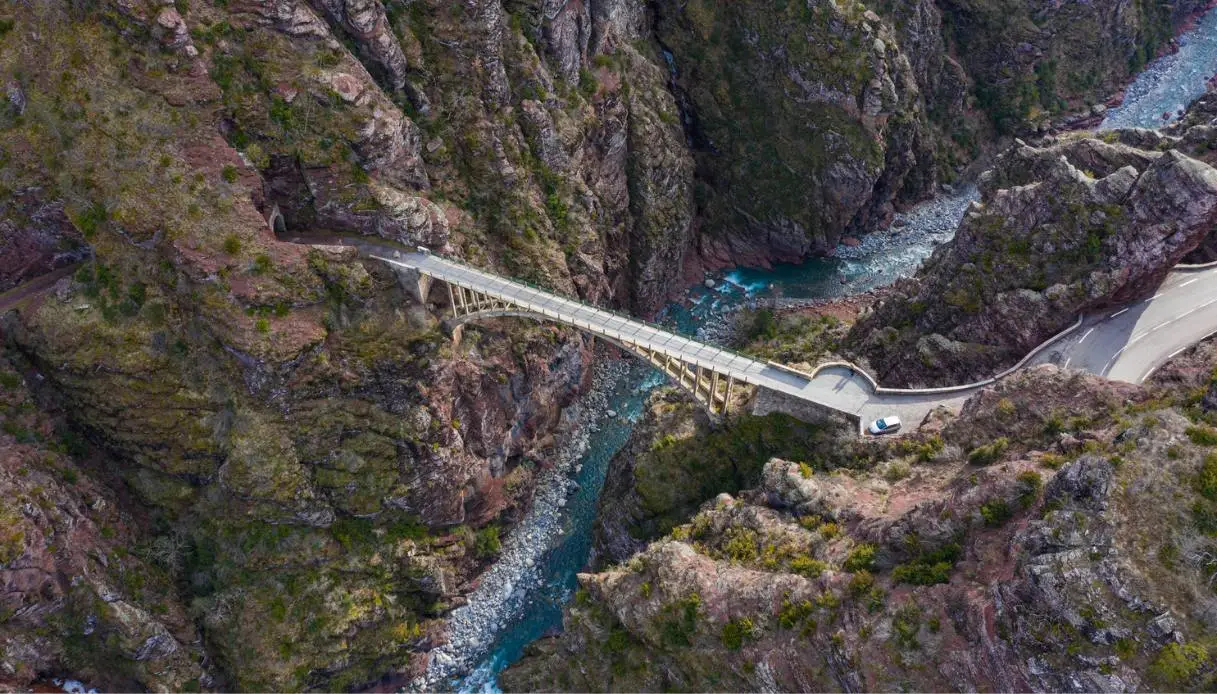
In this inland stretch near Nice, the greenery of the Maritime Alps yields to a long, deep red crevice. And it is right here that a road winds between towering walls, passes through rock-carved galleries, crosses bridges and runs alongside precipices that rise up to about 300 meters. Down below runs the Var, the river that has carved the canyon over millions of years.
It is this contrast that makes the Gorges of Daluis one of the most remarkable geological formations in southern France. The nickname “Nizzard Colorado,” or “Little Colorado of Nice,” becomes immediately understandable when faced with the wine-colored walls, so far from the classic image of Provencal mountains.
The gorge belongs to the Regional Natural Reserve of the Gorges de Daluis, established in 2012 and the first natural reserve designated in the Maritime Alps. The protected area covers over 1,000 hectares between the municipalities of Guillaumes and Daluis and preserves a geological, mineralogical, botanical, and faunal heritage of great interest.
Origins, formation and legends
About 270 million years ago, at the end of the Paleozoic era, Provence looked utterly different from today. The sediments that would form rocks called pelite were deposited within a vast rift—a large zone subjected to fracturing and movements of the earth’s crust, under a humid tropical climate.
Pelite is a relatively fragile sedimentary rock. Its characteristic burgundy-red hue results from the oxidation of iron embedded within. The result is a rock mass in unusual tones, pierced by fractures and engravings that erosion has gradually widened.
What shaped the current canyon was mainly the Var. For millions of years the river excavated the pelite, taking advantage of its fragility, to create a narrow gorge with vertical walls and deep overhangs. The result is truly impressive, with a crack more than 900 meters long and walls reaching about 300 meters above the watercourse.
The geology of the area becomes even more interesting when looking at the different colors of the rocks. Against the red of the pelite, the overlying calcareous formations contrast, and the white quartzite of the Triassic. This latter is a very hard rock, used also in the construction of some buildings and local artifacts, including the Pont de Berthéou.
Hidden under the walls is also a mining history: the Reserve safeguards over 70 mineral species catalogued in the various galleries of the area. Some minerals, including barroite and gilmarite, were identified for the first time precisely in this zone. Then there is the Pont de la Mariée, the Bride’s Bridge, perhaps the most famous point of the entire itinerary.
The quartzite bridge spans a void of around 80 meters and is tied to a tragic tale dating back to July 30, 1927. According to traditional accounts, a young bride on her honeymoon reached the gorge with her husband in the evening hours. The woman fell from the bridge under circumstances shrouded in doubt. The contemporary version attributed the fall to an error caused by darkness, while the incident inevitably fueled questions never fully resolved.
A little further on appears another singular presence: a block of red pelite that takes the shape of a female face and is called the “Guardian of the Gorges”. At the same time, Alpine and Mediterranean species share this environment, from chamois to rock partridge, from the golden eagle to the ocellated lizard.
The visit between panoramic road, belvedere and ancient galleries
The simplest way to get to know the gorge is to travel along the D2202, the road that crosses the Reserve and runs for about 11 km along the most spectacular stretch of the canyon. The asphalt makes the route accessible by car and motorcycle, but some sections are narrow, winding and perched over the void. The 17 galleries add a nearly cinematic element to the journey. Some are short, others deeper and unlit, so it’s advisable to go slowly and with care.
Take time for pauses: the road offers continuous views of the red walls, the Var, and the structures left by the old tram line. One of the most evocative stops is the Pont de la Mariée, from which the depth of the gorge is fully evident.
For those who want to explore the landscape on foot, the Point Sublime represents one of the most interesting experiences. The interpretive trail starts near the Berthéou bridge and leads to a belvedere overlooking the canyon. The hike takes about 2 hours round trip. From above, the Var seems much smaller than the walls that enclose it and the ancient Roua mines become recognizable in the landscape.
A more demanding experience is the Circuit des Balcons des Gorges de Daluis, a two-day loop of medium difficulty. The route crosses trails and tracks, includes a footbridge above the Var, a stretch with a ladder beside the rock face, ancient settlements and numerous viewpoints. A bivouac near Roua is planned, with mandatory reservation.
The vegetation appears almost clinging to the mountain: gorse, boxwood, thyme and juniper manage to grow on a substrate poor in water and nutrients. Among the rocks, species adapted to harsh conditions appear, while on the red surfaces you can also spot the small mollusks that symbolize the Reserve.
Being a protected natural area, the territory requires special attention. It is forbidden to collect rocks, minerals and plants, disturb wildlife and leave litter; dogs must be kept on a leash. The collection of geological samples is reserved for authorized researchers.
Where they are located and how to get there
The Gorges of Daluis lie inland in the Maritime Alps, between Daluis and Guillaumes, northwest of Nice. Their location makes them perfect for a broader itinerary through the upper hinterland of Nice, especially together with Entrevaux and the nearby Gorges du Cians.
From Entrevaux you follow the road toward Daluis and Guillaumes. The gorge gradually appears before the eyes, with the landscape changing to the great red walls. From Guillaumes the D2202 allows crossing the main stretch of the gorges along the Route des Grandes Alpes.
Those arriving by train can use the Entrevaux station, served by the Train des Pignes, located about 15 minutes from the Reserve. From Guillaumes you can also reach Valberg, an important alpine town in the Nice hinterland, and continue toward the Gorges du Cians to build an itinerary dedicated to the red canyons of the Maritime Alps.
The journey can continue toward Puget-Rostang, with a detour to the Ecomusée de la Roudoule, or toward Entrevaux, a fortified medieval village that offers an interesting historical counterpoint to the wild nature of the gorges.