
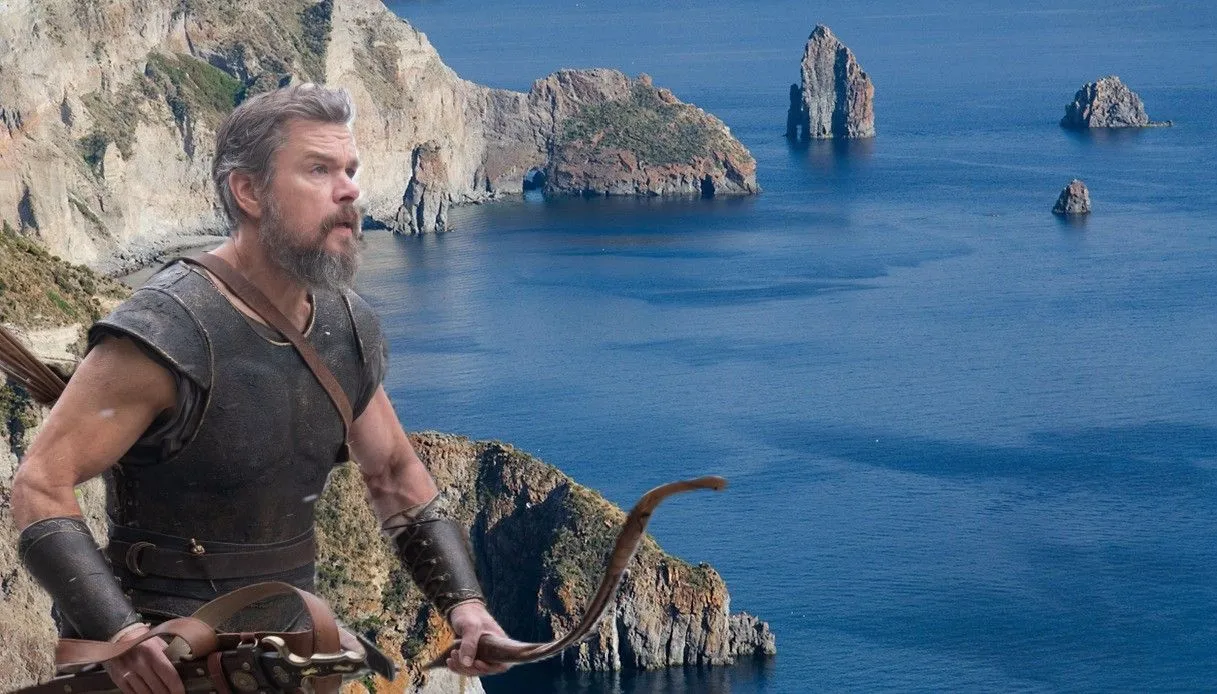
Odissea, the new cinematic adaptation of the myth of Odysseus hits theaters from July 16 2026, undoubtedly the event film of the year: because it was directed by one of the most influential living directors, Christopher Nolan; for an extraordinary cast including Matt Damon, Tom Holland, Anne Hathaway, Charlize Theron, Lupita Nyong’o, Zendaya, Robert Pattinson, just to name a few, and a budget that did not disappoint; because it is the first film shot entirely on IMAX 70mm film, which should guarantee unparalleled quality, but also because facing one of the foundational myths of Western culture is never a small undertaking.
The locations used for the filming of this masterpiece are numerous and reveal stunning places, from wild coasts to legendary islands and landscapes that seem to have stepped straight out of Homer’s epic.
What it’s about
Nolan’s new film focuses on Odysseus’s sea-faring adventures as, after the end of the Trojan War, he attempts to return to Ithaca but must contend with Poseidon’s wrath which, seeking to punish him for blinding his son, the giant Polyphemus, ensures that the journey lasts ten years.
During this time, aside from battling the sea in storms, Odysseus finds himself face to face with a string of characters such as Aeolus, the witch Circe, the sirens who try to enchant him with their song, Scylla and Charybdis, and above all the nymph Calypso who keeps him on her island for seven years. Odyssey, the film, as several critics have noted, seems to focus primarily on the psyches of the characters and the emotional impact of war and the denied return home.
Where the film was shot
It was Nolan himself who told the press that to best render the complexity of Odysseus’s journey, Odyssey was shot in numerous places, very different from one another: a choice that demanded a substantial portion of the budget be allocated to location scouting, and to the cast, crew, and the entire team long and frequent relocations, especially since the director preferred to minimize digital effects and shoot in real locations.
To map them, excluding studio scenes (mostly shot at Universal City Studios in California), the main locations of Odyssey are in Italy, Morocco, Scotland, Iceland, and obviously Greece.
Morocco
The very first scenes of the film, those depicting the final phase of the Trojan War when the city is besieged and set ablaze by the Greeks, were shot at Aït Ben Haddou: an ancient fortified city in Morocco, best known for its earth-and-stone ksar that since 1987 has been recognized as a UNESCO World Heritage Site and which in recent years has frequently served as a film set (for instance for some scenes of Game of Thrones).
Other Moroccan locations where Nolan’s Odyssey was filmed include Essaouira, Tahannaout, Marrakech.
On the White Dune of Dakhla, especially, the island of Ogigia where Odysseus would be held for seven years by Calypso was recreated: here the vast desert sands meet the turquoise waters of the ocean, creating mythic landscapes in the most literal sense of the term, but the area is also popular for kite-surfing, quad biking, and birdwatching.
Italy
The Aeolian Islands
In Italy Nolan and his crew shot mainly in Sicily. Among the locations for Odyssey are the Aeolian Islands where key episodes of Odysseus’s journey home are set.
On Lipari, more precisely, the director staged Odysseus’s meeting with the witch Circe: the rugged, still largely pristine landscape of the island seemed suited to tell one of the hero’s most daunting trials. The tranquil cove of Porto Pignattaro, with its small tourist marina, was used to moor the era’s sailing ships.
Pietra Lunga and Pietra Menalda, the two iconic sea stacks that separate Lipari from Vulcano, much loved also for diving, form the backdrop in Nolan’s film for the episode of the wandering rocks: the aim is etiological, as many reconstructions suggest that the gigantic rocks in perpetual motion from which spurting flames and smoke emerge, which Homer mentions in the Odyssey, would indeed be the Lipari Faraglioni.
On screen, those who have explored the Aeolian Islands by sea will have no trouble recognizing Panarea’s scenery, such as the islet of Basiluzzo or La Pietra del Bagno.
Favignana
Another Sicilian location for Odyssey is Favignana. The largest of the Egadi Islands was chosen as the setting for many sea scenes that had Cala Rotonda as a backdrop, but also to recreate ancient Greek ports on screen by taking advantage of the island’s picturesque fishing harbor, preserved as it was in the past; villages and camps were set up using the islet Preveto and lookout points like the one recreated inside Santa Caterina Castle which, from above, dominates the island.
Ostia and Tivoli
Among the locations where Odyssey was filmed in Italy is also Lazio. In Ostia, Nolan and the crew were spotted near the marina and the seaplane base. More interesting, at least from a scenic and naturalistic perspective, is the choice to shoot near Tivoli close to the former pozzolana quarry (or Corcolle Quarry) and the Real Lakes Park. Not far from the most important Roman villas of Tivoli, the latter is a green area where one can practice sport fishing, as well as stop for a picnic or for a lakeside dinner with a view.
Greece
In Odyssey, Greece was mainly filmed in the southern region of the Peloponnese to stay as faithful as possible to Homeric settings. The scene of Polyphemus’s blinding was set, for example, in the Nestor’s Cave: a large chamber filled with stalactites and stalagmites reached by a footpath that starts from Voidokilia Beach. The latter has an iconic horseshoe shape and a stretch of white sand that leads to crystal-clear water, enough to be considered among Greece’s most beautiful beaches.
Other scenes were shot inside the Methoni Castle: a complex structure enriched over time by the various populations that ruled it – including the Venetians – to defend the town of Methoni, once one of the Peloponnese’s most important mercantile centers.
Among Odyssey’s Greek locations is also the archeological site of Acrocorinth: more than 240 acres that overlook the city of Corinth, once dedicated to the worship of the goddess Aphrodite, and where today it’s easy to see traces of the many dominations that have succeeded in the area, including Byzantine churches, Ottoman mosques, and Venetian towers.
Moving to Crete, the production of Nolan’s new film shot at another of Greece’s beloved beaches: Almyros, a stretch of fine sand that gently slopes into the sea and is thus perfect for travelers with children, located between the mouth of the Almyros River and Mount Thrypti.
Other locations of “Odyssey”
From the production plan, it’s evident that there are places where Odyssey was also filmed in Malta: not much is known about which ones, but the Nolan team apparently could not resist the island’s current allure for film productions (for instance, Enola Holmes 3 was shot there recently).
Similarly, little is known about Odyssey’s locations in Iceland: a destination long dear to Nolan, who has often used it as a setting for his films. The director’s team was frequently spotted in Reykjavík: the capital, not only political but also historic, artistic, and cultural, a city in many ways modern and forward-thinking, yet still carrying a Viking soul. A naval set near the Landeyjahöfn jetty, which mainly connects the mainland to the Vestmannaeyjar (Westman Islands) archipelago, sparked curiosity: a group of seven volcanic islands, of which only one is inhabited.
Scotland
In Scotland, among the clearly recognizable Odyssey locations is Culbin Forest: a dense woodland area dominated by pines and understory plants, which gradually thins out toward the coast into sandy clearings, creating a habitat ideal for many butterfly and flying species.
As with the entire site, it’s frequented by naturalists and nature lovers, as well as mystery enthusiasts who value the presence, hidden among the trees, of monoliths bearing coded messages.
The forest overlooks the Moray Firth Fjord: one of Scotland’s most spectacular in the north, still off the mass tourist routes, perfect to convey on screen the tension of Odysseus’s struggle against a population of man-eating giants.
On the promontory of this fjord lies the Findlater Castle, or rather what remains of it: among the ruins of this 13th-century fortress, passed from one noble family to another, Nolan’s reinterpretation of the Homeric myth yielded additional scenes.
The coastal town of Buckie with its characteristic fishermen’s houses and its picturesque harbor is another Scottish Odyssey location: here, for months, the ship of Odysseus was moored in this cinematic version.
The production also shot in Burghead: another small seaside town that some sources claim has been inhabited since the Iron Age, famous for the ease with which whales and dolphins can be seen along its shores and for the Fire Festival.
With such an abundance of settings and scenery, it’s no wonder that Nolan’s Odyssey fuels, as seems to be already happening, the growing set-jetting phenomenon.