
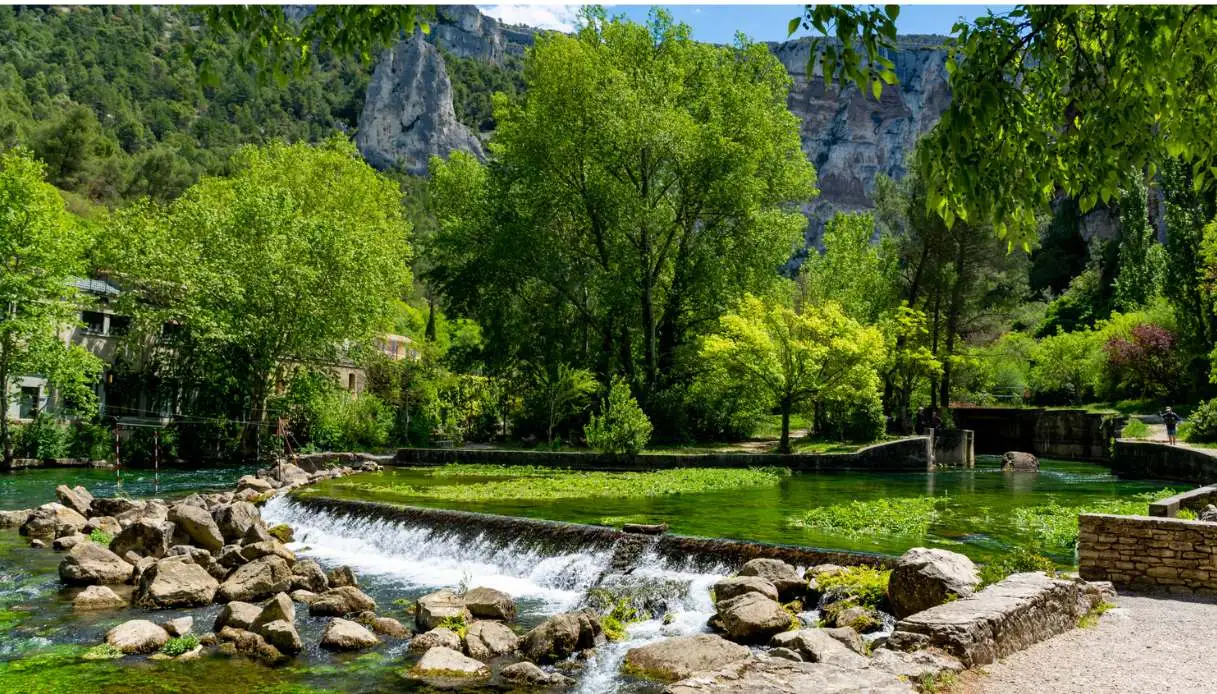
About 30 kilometers from Avignon, at the end of a narrow valley squeezed between limestone walls, Fontaine-de-Vaucluse seems to have paused at the precise point where Provence changes its character. The sunlit meadows, vineyards, rows of lavender and perched villages give way to a deep, cool, shaded gorge. At the bottom, at the foot of a 230-meter-high cliff, the water surfaces from the underground and gives life to the Sorgue.
Everything starts from there: the village gathers along the course of the river just born, among old stone houses, footbridges, moss-covered waterwheels and small alleys. The Sorgue crosses Fontaine-de-Vaucluse with a color that changes under the light, shifting from deep turquoise to emerald green. It is a cold water, clear and constantly fed by a gigantic underground system.
But that’s not all, because the spring has a peculiarity that makes this place unique: before the eyes appears a cavity seemingly silent, but beneath that surface opens an abyss explored only in part. Investigations have reached about 315 meters in depth without being able to fully clarify the course of the underground galleries. Fontaine-de-Vaucluse has thus given its name to an entire hydrogeological model. The large springs fed by underground karst networks are indeed called vauclusian springs.
Origin, formation and legends
Fontaine-de-Vaucluse represents the principal spring of metropolitan France and one of the largest resurgences on the planet. Its operation depends on a vast underground basin fed by rainfall and by the melting of snow coming from Mont Ventoux, the Monts de Vaucluse, the Albion Plateau and the Montagne de Lure. The catchment area covers over 1,200 square kilometers.
The water slowly seeps into the limestone rocks, travels through a complex underground network, and reappears at the base of the cliff. On average hundreds of millions of cubic meters of water gush forth each year. During the driest periods the flow remains high, while in spring or after particularly intense rainfall the landscape undergoes a radical transformation.
The water level rises, passes the natural threshold, and the spring roars down the rocks with impressive force. The Sorgue maintains a particularly steady temperature, around 13 degrees, a feature that contributes to its clarity and the presence of a rich ecosystem.
During the 19th and 20th centuries, numerous expeditions attempted to penetrate the mystery of the abyss. In 1878 the Marseille diver Ottonelli reached 23 meters. In 1946 came the group led by Jacques-Yves Cousteau. Subsequent explorations pushed divers to ever greater depths. In 1983 Claude Touloumdjan and Jochen Hasenmayer descended to about 205 meters, while robotic devices allowed reaching beyond 300 meters.
The known depth, however, represents only a portion of the system: investigations have identified galleries that continue beyond the point reached by explorations. For this reason Fontaine-de-Vaucluse continues to keep part of its mystery.
Alongside its real history, Fontaine-de-Vaucluse also guards a legend. The church of Notre-Dame-et-Saint-Véran is linked to the figure of Saint Véran, to whom tradition attributes the liberation of the region from the Couloubre, a dragon-like monster that terrorized the inhabitants. The saint is said to have faced the creature and driven it from the valley, becoming a deeply rooted figure in local memory.
Even Petrarch contributed to building the area’s aura. The poet lived in Fontaine-de-Vaucluse between 1337 and 1353, and the valley’s nature entered his poetic imagination. The Sorgue, the solitude of the gorge and the rocky landscape represented a refuge far from courts and great cities. Laura, a central figure of his poetry, remains tied to this period of his life and has transformed the village into a stop on Europe’s literary geography.
Visiting Fontaine-de-Vaucluse
The historic center is compact, and a visit can take only a few hours, though it’s worth slowing down and spending time along the Sorgue’s banks. From the heart of the town starts the Chemin de la Fontaine, the short path that runs along the river up to its source. The distance is about 500 meters.
At the end of the valley appears the great limestone wall. Down below, protected by safety barriers, lies the cavity from which the river springs. Direct access may be restricted for safety reasons, also due to the risk of falling rocks from the cliff. It is therefore worth observing the spring from designated viewpoints and following the signage.
A key stop is the Moulin à Papier Vallis Clausa, a testimony to the village’s long papermaking tradition. The first paper mill dates back to 1522, and the paper industry represented a fundamental economic resource for Fontaine-de-Vaucluse until the last operation closed in 1968. Today the mill shows the old papermaking techniques through the movement of water and the processing of rags.
The great water wheel, with a diameter of about 7 meters and 48 blades, remains one of the village’s most recognizable images. Watching it turn before the building helps to understand the direct relationship between the Sorgue and the local crafts. On the opposite side of the Sorgue lies the Musée Pétrarque, dedicated to the stay of the Italian poet and to the lasting influence of his figure in the following centuries.
Also worth a stop is the church of Notre-Dame-et-Saint-Véran, a medieval building built on the remains of an ancient place of worship. In the town center, Place de la Colonne is where village life concentrates. The column dedicated to Petrarch was inaugurated on July 20, 1804, on the occasion of the 500th anniversary of his birth.
Looking up toward the mountain, the remains of the castle of the bishops of Cavaillon can be seen, built in the 13th century on a rocky spur. Most of the stone structures survive, but the location helps convey the valley’s strategic value. The castle controlled a territory traversed by pilgrims heading toward the sanctuary of Saint Véran.
Where it is and how to get there
Fontaine-de-Vaucluse sits in southeastern France, in Provence, in the department that bears its name. Avignon is roughly 30 kilometers away, while L’Isle-sur-la-Sorgue lies about 8 kilometers away. Driving remains the most practical way to reach the village, especially for those planning a Provence itinerary.
From Avignon the journey typically takes just under an hour, depending on traffic and the chosen route. Fontaine-de-Vaucluse can easily be folded into a day devoted to Sénanque Abbey, the Luberon, or the villages of the Sorgue valley. From Avignon’s train station, connections generally require a combination of train and bus or a car transfer.