
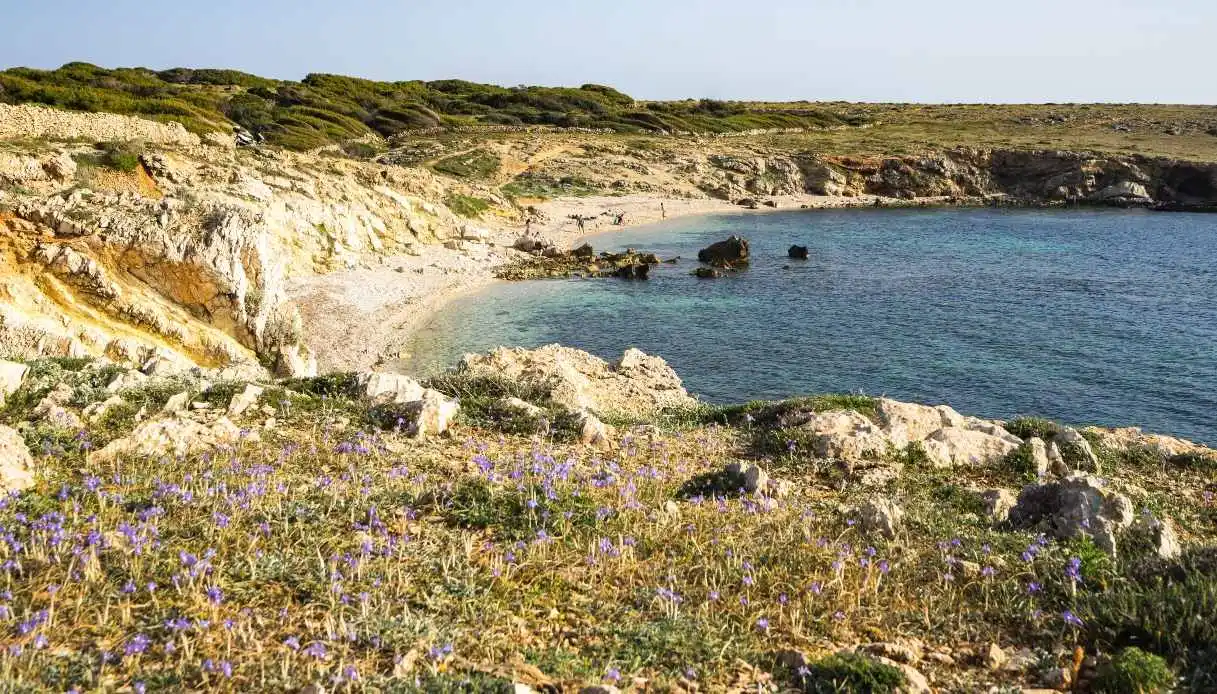
The release of Odyssey by Christopher Nolan has rekindled the desire to discover the places that served as the backdrop to Odysseus’s journey. Among the film’s most spectacular locations stand some beaches and coves with a wild charm, capable of evoking the Mediterranean as told by Homer. But Nolan’s is only the latest production to transform natural landscapes into cinematic sets.
In this case, however, it is precisely the coasts chosen by the director that tell the myth: islands, bays, and beaches where the sea becomes the protagonist of the long voyage of the Greek hero toward Ithaca.
Cala Rotonda, Favignana
The island of Favignana, in the Aegadian Islands, captured Nolan at first sight: “We looked for more practical and easily accessible locations, but we could never shake Favignana from our minds,” the Oscar-winning director reportedly stated.
Among the beaches tied to Odyssey there is Cala Rotonda. The production chose this corner of Sicily to shoot some scenes set during Odysseus’s sea voyage, taking advantage of a landscape characterized by clear waters, wind-sculpted cliffs, and a still-wild nature, but also to recreate ancient Greek ports.
On Favignana, the islet Preveto was also used as a film set.
The Coasts of the Aeolian Islands
Even the Aeolian Islands were chosen as a backdrop for some sequences of Odyssey. The Sicilian archipelago, with its volcanic coasts, deep waters, and landscapes shaped by the fire of the earth, has long been associated with the myth.
Among the locations involved in the filming are several coastal areas of the islands, including Lipari with the cove of Porto Pignattaro and with the two famous sea stacks that separate the island from Vulcano (Pietra Lunga and Pietra Menalda).
Additionally, the film features glimpses of Panarea, and in particular Pietra del Bagno and the islet of Basiluzzo.
Voidokilia Beach, Peloponnese
In the Peloponnese, one of the most recognizable beaches tied to Odyssey’s filming is Voidokilia Beach, regarded as one of Greece’s most spectacular bays. Its crescent-shaped form, pale sand, and turquoise waters have made this beach an ideal location to bring the world of ancient Greece back to the big screen.
From Voidokilia begins a walking trail to the Nestor’s Cave, a hollow covered with stalagmites and stalactites.
Almyros Beach, Crete
Among the beaches chosen by Christopher Nolan for the Odyssey film is Almyros Beach, one of Crete’s most evocative coastal stretches. Located near Agios Nikolaos, in the island’s northeastern part, this long white-sand shore stands out for its natural landscape that blends crystal-clear sea with the Almyros River delta and the inland mountains.
The beach was selected by the production for its ability to evoke an ancient, unspoiled world, perfect for telling Odysseus’s journey far from civilization.
The White Dune of Dakhla, Morocco
Among Odyssey’s most striking coastal locations is also the White Dune of Dakhla, in Western Sahara. Here the desert meets the ocean, creating an extraordinary setting, chosen by Nolan to represent the mythical island of Ogygia, where Odysseus is detained by the nymph Calypso for seven years.
The pale sand expanse rising from the turquoise waters of the Atlantic offers an almost unreal landscape, capable of uniting isolation, natural beauty, and a sense of legend. A beach unlike the classic Mediterranean shores, but perfect for water sports as well.