
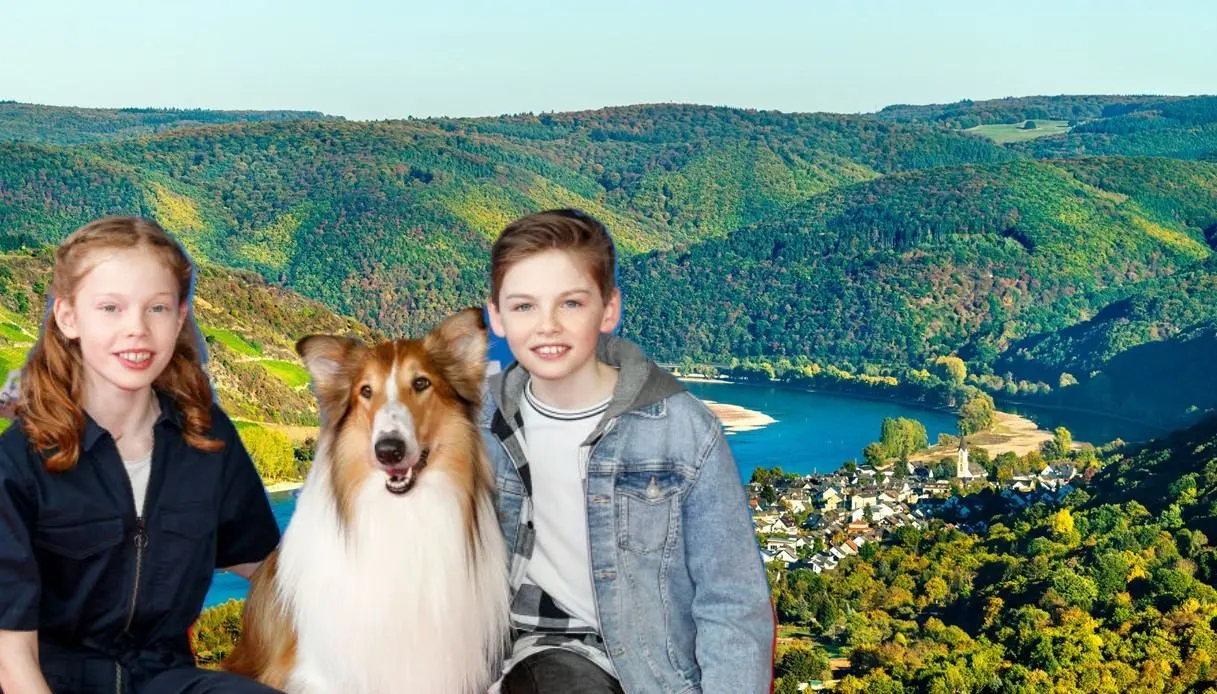
Lassie, the dog we all adored as kids, returns to prime time on Rai 1 – Tuesday, August 25, 2026 – thanks to a remake of the Forties classic featuring Elizabeth Taylor. The remake differs from the originals in both its settings and the locations of Lassie Comes Home, yet the aim remains the same: to tell a tale of deep friendship between humans and animals and to celebrate a slower, more bucolic lifestyle that values a bygone era in some ways.
Join us as we explore the captivating corners of Germany where the film directed by Hanno Olderdissen was shot.
What it’s about
Florian, a young boy, and his dog Lassie have become inseparable after growing up together. When their parents lose their home and employment and must entrust the animal to the elderly Count von Sprengel and his granddaughter Priscilla, Lassie runs away and does everything in her power to find her way back home. What the dog faces is an adventurous journey, full of obstacles, dangers, and unexpected encounters. Fortunately Florian and Priscilla have joined forces in the meantime and have set off to locate Lassie.
Where the film was shot
Unlike the original 1943 film featuring Liz Taylor, which unfolds entirely in the United States, and the novel (“Lassie Come-Home” by Eric Knight) set against the backdrop of the Scottish Highlands, the 2020 remake is staged in Germany: most of the action takes place in a small town somewhere in Germany. The filming locations for Lassie Comes Home span from Berlin to the state of Brandenburg and to North Rhine-Westphalia.
Luckenwalde
The scenes of arrivals and departures, so central to Florian and Lassie’s adventure, were shot at the Luckenwalde train station. Located about an hour from Berlin, this Brandenburg town still bears the marks of its industrial roots: Gründerzeit-era architectures, including the station itself, are among the must-see attractions.
Just outside the city, the Nuthe-Nieplitz Nature Park is ideal for hikes, treks, and nature strolls.
Berlin
Many exterior scenes and city views were shot in Berlin: the vibrant energy of the German capital serves as a fitting metaphor for the adrenaline Florian and Lassie must feel on their journey as they relentlessly search for each other.
North Rhine-Westphalia
Among the locations of Lassie Comes Home is also North Rhine-Westphalia: in this green region, where rolling hills and river valleys prevail, the most bucolic sequences of the remake were filmed—those that invite viewers to slow down and rediscover the values of days gone by, such as faithful friendship. The area is also renowned for its medieval castles, some perfectly preserved and others reduced to ruins, which adds an extra layer of magic and uniqueness to the atmosphere.
Studio Babelsberg, Potsdam
For studio work, the production relied on the Studio Babelsberg in Potsdam: located in the eponymous district and widely used by European and international productions, it is the second-oldest film studio in the world.
Other locations in the Czech Republic
Beyond Germany, several scenes of the family classic remake were filmed in the Czech Republic: here, small villages, picturesque historic centers, and wide green spaces were chosen to represent Bavaria on screen.
Vlachovo Březí, Prachatice, Majdalena-Lužnice are among the main Czech locations for Lassie Comes Home: they provide the backdrop to the dog’s escape and the adventures Florian and Priscilla share as they strive to reunite with him.
The sequences inside the glass factory were filmed at the historic glassworks of Harrachov: the Sklárny Novosad a syn is Bohemia’s oldest private glassworks where chandeliers, goblets, and other glass objects are still shaped using traditional techniques of yesteryear.