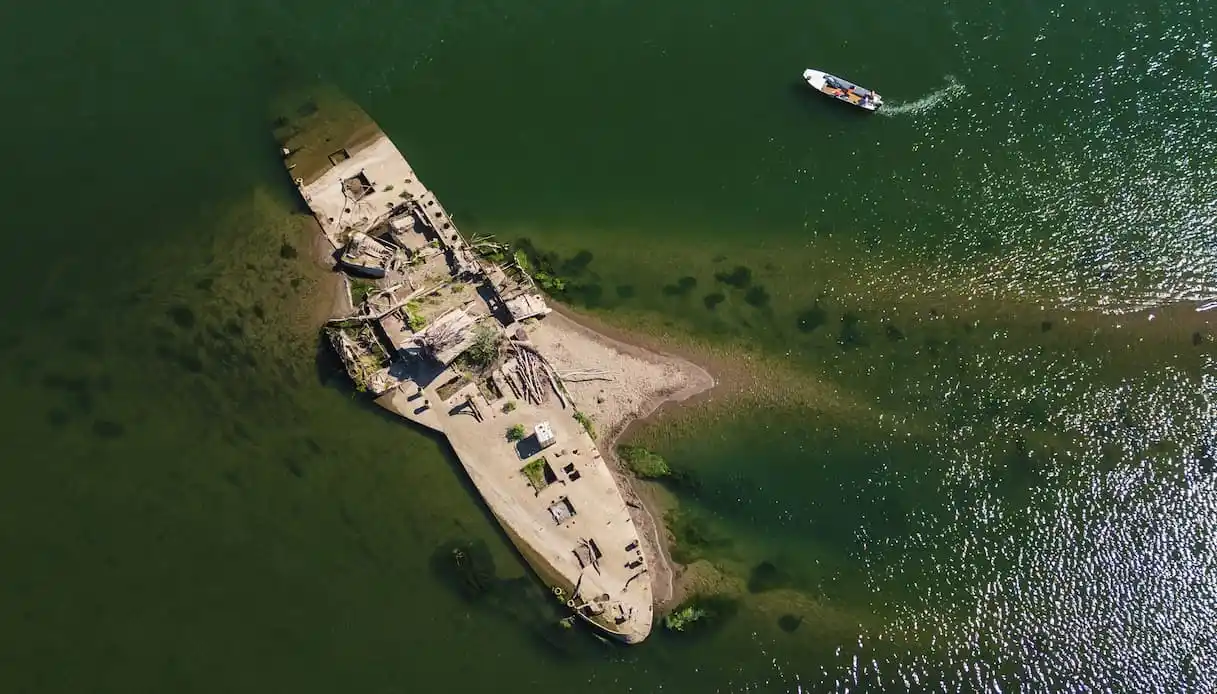
Climate change continues to surprise us more and more, in both negative and positive ways. The level of European rivers is falling and, together with the water, relics and testimonies from distant eras resurface. This is exactly what is happening now in Serbia, where from the waters of the Sava River the wreck of a steamship built in 1913 has reappeared, having lain on the river bottom for more than 80 years.
The vessel is the Slovenian, an old tug about 54 meters long, which Serbian media have even nicknamed the “Sava’s Titanic”, the Titanic of the Sava. The wreck surfaced again at the beginning of August near Sremska Mitrovica, roughly 70 kilometers to the northwest of Belgrade, due to the exceptionally low water level. According to locals, parts of the boat had previously broken the surface, but never so clearly. The latest appearance has drawn the attention of the local population and historians, bringing to light a story that spans two world wars.
The Story of the Sava’s Titanic
The story of the Slovenian begins in 1913, when the ship was built in a Budapest shipyard, then part of the Austro-Hungarian Empire. Originally it was named Vag, after the Hungarian name of the Váh River, the main Slovak tributary of the Danube. Measuring about 177 feet in length, equivalent to 54 meters, it carried a steam engine and served as a tugboat to haul heavy loads along the Danube, linking Budapest with other locations along the river.
Its activity was heavily shaped by the First World War. At the end of the conflict, with the dissolution of the Austro-Hungarian Empire, the vessel passed to the newborn Kingdom of Serbs, Croats and Slovenes, which would later become Yugoslavia, as part of war reparations. It was precisely in this period that its name changed and it was renamed the Slovenian.
But the ship’s saga did not end with World War I. The Slovenian also endured World War II, when Yugoslavia was occupied by Nazi Germany. After the liberation of Belgrade in 1944, the Yugoslav partisans used the ship to transport wounded and equipment, while German troops were pushed back west. Its final mission arrived a few months later, when in late April 1945, while carrying wounded fighters, the Slovenian struck a German mine in the Sava River. The vessel sank and, according to historical reconstructions, remained in the same spot ever since.
Why the wreck has resurfaced precisely now
The Slovenian’s new appearance is tied to a broader phenomenon affecting Europe: drought and falling water levels in major rivers. The year 2026 has been marked by extremely high temperatures and a prolonged lack of rainfall. According to the Copernicus Climate Change Service, Europe is the continent that is warming the fastest in the world, and since the mid-1980s temperatures have risen at roughly twice the global average.
By the end of July, about half of the European Union and the United Kingdom were affected by drought, while 9% of the territory stood at the most severe alert level. The Sava’s low water level has thus brought the wreck far closer to the surface than in previous years, allowing observers to glimpse parts of the corroded hull that would normally remain underwater. The Slovenian is not the only historical relic returned by Europe’s rivers during this drought phase. In the Danube, especially in the eastern part of Serbia near the Romanian border, the remains of several German ships sunk during World War II have reappeared.