
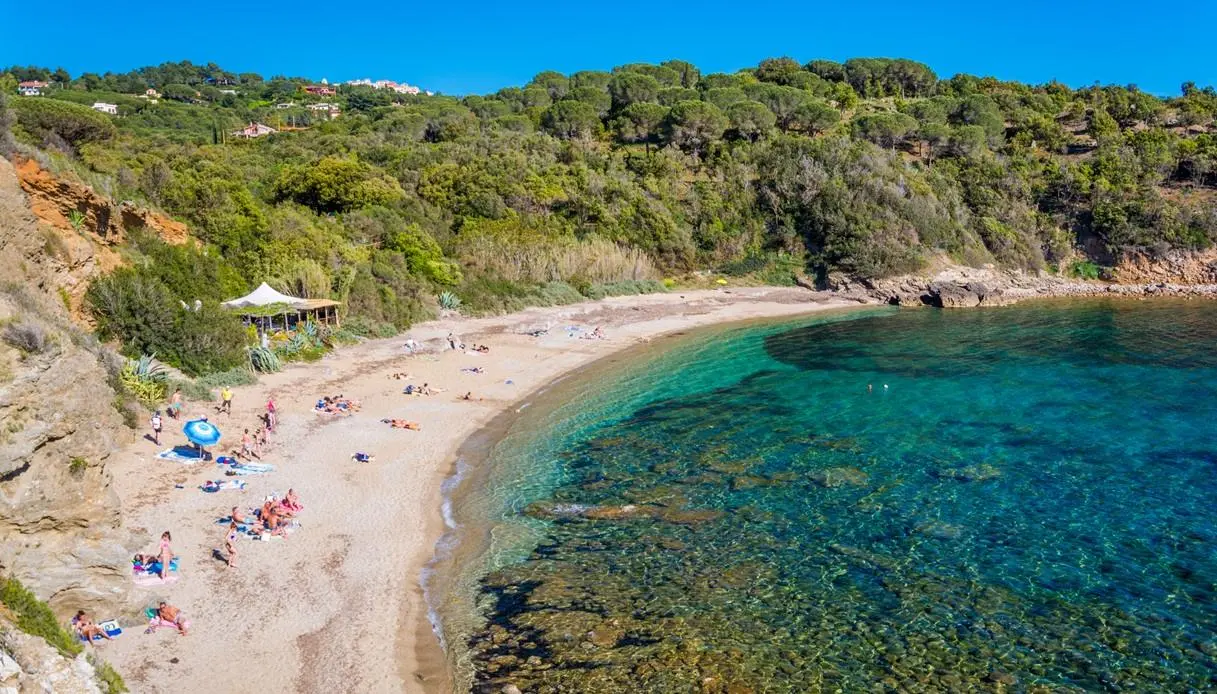
The Tuscany once again captures the attention of the international press, but this time it isn’t Florence, Siena, or the Val d’Orcia that end up in the spotlight. What captivates the Guardian are instead the less crowded places, surprising paradisiacal refuges far from the most renowned destinations: the splendid islands of the Tuscan archipelago.
The British publication has invited its readers to leave the art-filled cities for a few days to reach 5 islands, each with a distinct character: from the lively Elba to the very small Giannutri, described as a true “radical detox from modern life.”
The Tuscan Islands That Win Over the Guardian
The Guardian starts from a fact that makes the archipelago particularly fascinating: the seven islands that compose it lie between the Tuscan coast and Corsica and all form part of a protected national park. They are not all alike, though: some are lively and well-served, others are small, wild, and with access that is heavily regulated.
The first is Elba Island, the largest and best known, which the Guardian playfully defines as “the man for all seasons.” Here coexist the history of Napoleon’s exile, the Medici fortifications, the hilltop villages, the magnificent beaches, and the 58 kilometers of the Grande Traversata Elbana (the most famous hiking route that crosses the entire island from east to west).
Then there is Giglio Island, which covers barely 21 square kilometers, but can win everyone over with its three villages, terraced vineyards, coves, and that atmosphere that in August is further protected by restrictions on car circulation. For the Guardian it is the ideal island for those seeking a slower vacation, between the fortified village of Giglio Castello and the crystal-clear waters of its beaches.
More wild is Capraia, one of the archipelago’s most remote islands. Few roads, almost no cars, and ancient trails that run through cliffs, coves, and Genoese fortifications: a landscape that, according to the British daily, is best discovered on foot.
From Pianosa to the Small Giannutri, Tuscany’s Hidden Side
The Guardian’s journey continues to Pianosa, where the daily visitors’ number is limited to protect a particularly fragile environment. The island houses traces of Roman presence, Christian catacombs, and the buildings of the ancient penal colony. Here too tourism follows precise rules: guided walks, cycling excursions, and kayaking are among the best ways to explore it.
Finally comes Giannutri, the smallest and perhaps the most surprising of the five. It is an island without roads and without cars, where the Mediterranean scrub descends toward a sea in deep tones. The Guardian presents it as a place capable of offering a “radical detox from modern life”: here there is a single restaurant-café, few services, and a coastline largely part of a marine reserve.
For those who reach this far, exploring Cala Spalmatoio and Cala Maestra, snorkeling or diving, and taking a guided tour of the Roman villa tied to the Domitii Ahenobarbi family are musts.
The Guardian’s tour thus reveals all the charm of these five Tuscan islands, distant from the more trodden routes and able to win travelers’ hearts at every single turn.