
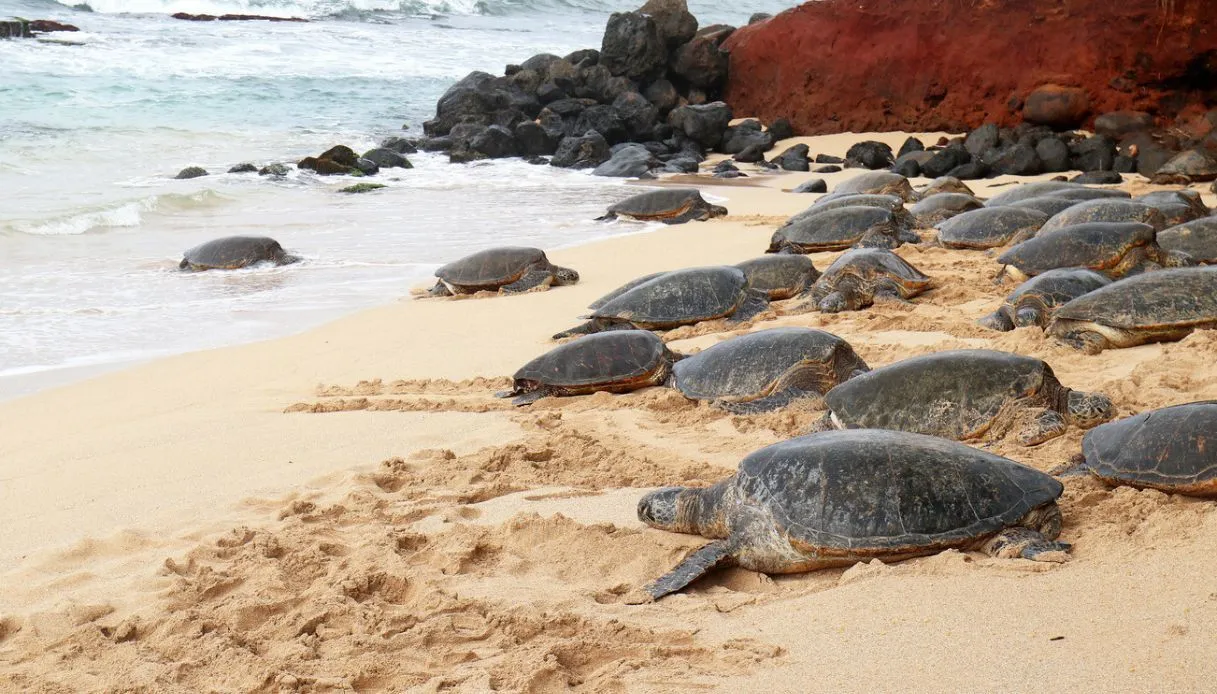
Imagine a beach that, within two days, becomes home to more than 330,000 sea turtles busy digging holes in the sand to lay their eggs. It isn’t a scene from a nature documentary, but what just happened along the coasts of Oaxaca, in southern Mexico, where one of the season’s most impressive arribadas occurred.
Arrival of sea turtles at La Escobilla
The Spanish term arribada, literally meaning “arrival,” denotes one of the most spectacular phenomena in the animal kingdom: the synchronized, mass nesting of the olive ridley sea turtles (Lepidochelys olivacea). Unlike other sea turtle species, which nest in scattered, solitary events, the olive ridleys opt to emerge from the sea all at once, within a very brief window, turning the shoreline into an anthill of shells and flippers.
That is precisely what happened on the La Escobilla beach in the state of Oaxaca: in less than 48 hours, more than 330,000 individuals arrived, the sixth arribada since the season began in March. An astonishing figure, but one that should be read with a note of concern. As one expert stated, climate change now poses a tangible threat to the species’ survival, capable of altering sand temperatures (which determine the sex of the hatchlings) and the ocean currents that guide the turtles toward the shores.
Beyond their allure, olive ridley turtles play an ecological role far from marginal. According to Profepa (the Mexican federal environmental protection agency), they help transport nutrients from the sea toward beach and dune ecosystems and assist in maintaining balance among the jellyfish and sponges they feed on. In other words, their presence (or absence) has repercussions for the health of the entire coastal ecosystem.
Where to see the arribadas on the Oaxaca coast
La Escobilla is not the only site to witness this natural spectacle. Along the Pacific coast of Oaxaca state lies also Morro Ayuta, in the Isthmus of Tehuantepec region, regarded as the second most important sanctuary in the area for the mass arrival of olive ridley turtles. Here too, Mexican environmental authorities maintain a fixed presence during the season to protect nests from poaching and monitor the deposition trends.
Arribadas occur several times a year, with peaks ranging from a few thousand to hundreds of thousands of individuals within a few days. Anyone wishing to observe the phenomenon up close can do so through ecotourism programs active in both zones, often run in partnership with local communities and conservation associations. In addition to witnessing the adult turtles’ arrivals, one can also experience the equally thrilling moment of releasing the hatchlings into the sea.
The best-known place to experience this is Mazunte, a short distance from La Escobilla, where the Mexican Turtle Center has for years organized guided environmental education routes and hatch releases open to the public. The nearby Ventanilla beach, run by a local cooperative, offers similar moments, as do other areas along the Oaxaca coast where various protection camps monitor the nests up to hatching.
It is no surprise that in recent years a hospitality offering tailored for this kind of tourism has emerged. Along the Mexican coasts most tied to turtle nesting, upscale hotels with a strong emphasis on marine conservation have appeared, equipped with protected nesting zones, genuine internal incubation centers, and reduced-night lighting policies to avoid disorienting the animals during the most delicate phases.